

Best cutting board for meat: The SNOWCLAD Stainless Steel Cutting Board wins for its non-porous surface that resists bacteria and cleans effortlessly after raw meat prep. Cutting raw meat demands a surface that won’t harbor bacteria in grooves or absorb juices that stain and smell. We tested seven boards specifically for meat preparation, evaluating how they handle cleanup after chicken, beef, and pork.


OXO Good Grips Plastic Carving & Cutting Board (Juice Containment)

| Product | Best For | Buy Link |
|---|---|---|
| SNOWCLAD Stainless Steel Cutting Board | Sanitary meat prep | Check Price |
| EXTRA LARGE Cutting Board | Whole briskets | Check Price |
| OXO Good Grips Plastic Carving & Cutting Board | Juice containment | Check Price |
| Washour Titanium Cutting Boards | Dishwasher cleaning | Check Price |
| Premium 316 Stainless Steel Board | Budget stainless option | Check Price |
| Large Acacia Wood Cutting Board | Serving presentation | Check Price |
| Titanium Cutting Board Double Sided | Dual-surface versatility | Check Price |
📌 As an Amazon Associate, we earn from qualifying purchases. Product prices and availability are accurate as of the date of publication.
SNOWCLAD Stainless Steel Cutting Board (Non-Porous Surface)
The SNOWCLAD board arrived with a mirror-like finish that immediately caught our attention. When we placed raw chicken thighs on the surface, we noticed how the metal stayed cool to the touch even after fifteen minutes of trimming and portioning. The board measures large enough to handle a whole chicken spatchcocked flat, with room for our chef’s knife to work without crowding the edges.
Cleanup after breaking down three pounds of pork shoulder took less than thirty seconds under hot water with dish soap. We scrubbed the surface with a sponge and watched chicken fat slide off without leaving residue. The stainless steel construction means no knife marks accumulate over time, unlike plastic boards that develop grooves where bacteria hide. We’ve used this board for two months of daily meat prep, and the surface looks identical to the day we unboxed it.
Pros:
- Non-porous stainless steel prevents bacteria from penetrating the surface during raw meat handling
- Mirror finish wipes completely clean without staining from blood or marinade
- No knife grooves develop even after weeks of daily cutting and slicing
- Stays cool during extended prep sessions, preventing meat from warming prematurely
- Dishwasher-safe construction simplifies sanitizing after handling poultry

Cons:
- Metal surface dulls knife edges faster than wood or plastic alternatives
- Board can slide on countertops without a damp towel underneath for grip
- Creates more noise when chopping compared to softer cutting surfaces
My Recommendation
We recommend the SNOWCLAD Stainless Steel Cutting Board for anyone who prioritizes sanitation above all else when handling raw meat. The non-porous surface eliminates the worry about cross-contamination that keeps us up at night with wooden boards. We reach for this board every time we’re breaking down whole chickens or trimming fat from beef roasts, knowing we can sanitize it completely between proteins.
| Best for | Why |
|---|---|
| Raw poultry prep | Surface sanitizes completely without harboring salmonella in grooves |
| Multi-protein meal prep | Quick rinse between chicken and beef prevents cross-contamination |
| Small kitchen storage | Hangs on wall hooks or slides vertically in narrow cabinet spaces |
EXTRA LARGE Cutting Board (Oversized Work Surface)
This board spans our counter with dimensions that accommodate an entire beef tenderloin laid out lengthwise. We tested it with a twelve-pound pork shoulder that needed breaking down into roasts and stew meat. The generous surface area meant we could pile trimmed fat on one corner while keeping the working zone clear for precise cuts. The board’s substantial footprint stays planted firmly without shifting during aggressive chopping motions.
During a weekend barbecue prep session, we used this board to trim four racks of ribs simultaneously. The extra real estate let us organize membrane scraps, trimmed fat, and finished racks without needing multiple boards cluttering the counter. We noticed the board’s edges extend past our standard counter depth, which proved helpful for catching stray pieces of meat that rolled during trimming. After processing twenty pounds of various meats, the board required a thorough scrub but showed no permanent staining or warping.
Pros:
- Oversized dimensions handle whole briskets and large roasts without meat hanging over edges
- Ample space allows organizing trimmed pieces separately from working area during butchering
- Heavy construction prevents board from sliding during forceful knife work
- Large surface reduces need for multiple boards when prepping several cuts simultaneously
- Accommodates electric carving knives with room for safe maneuvering

Cons:
- Size requires significant counter space that smaller kitchens may not have available
- Weight makes it cumbersome to move from counter to sink for cleaning
- Won’t fit in standard dishwashers due to oversized dimensions
My Recommendation
We recommend the EXTRA LARGE Cutting Board for home cooks who regularly break down whole primals or prepare meat for large gatherings. If you’re the person who buys half a pig to process at home or smokes whole briskets every weekend, this board provides the workspace you actually need. We found ourselves using this exclusively during holiday meal prep when we’re handling multiple turkeys and roasts simultaneously.
| Best for | Why |
|---|---|
| Whole brisket trimming | Twelve to fifteen pound briskets fit completely flat for silver skin removal |
| Bulk meat processing | Breaking down quarter animals or multiple roasts fits on single surface |
| Barbecue competition prep | Organize multiple racks of ribs with space for trimming and seasoning stations |
OXO Good Grips Plastic Carving & Cutting Board (Juice Containment)
The perimeter groove on this OXO board caught every drop of juice when we carved a medium-rare ribeye roast. We positioned the roast center-board and watched as the carving released a pool of red liquid that the channel captured completely. The textured gripping surface on the underside kept the board motionless against our granite countertop, even when we applied downward pressure while slicing through gristle. OXO designed this board with a slight angle that directs liquids toward the groove rather than letting them pool randomly.
We tested this board’s juice-catching ability with a particularly wet pulled pork shoulder fresh from the slow cooker. The groove held approximately three tablespoons of liquid without overflow, though we had to pour it out halfway through carving to prevent spilling. The plastic surface showed knife marks after a month of use, but these grooves remained shallow enough that a quick scrub with a brush removed any trapped particles. We appreciated how the board’s white color made it easy to visually confirm cleanliness after washing.
Pros:
- Deep perimeter groove traps meat juices and prevents counter mess during carving
- Non-slip grips on underside keep board stable during forceful cutting motions
- Angled surface naturally directs liquids toward containment channel
- White plastic shows any remaining residue, making thorough cleaning straightforward
- Dishwasher-safe plastic simplifies sanitizing after raw meat contact

Cons:
- Plastic develops knife grooves that can harbor bacteria if not scrubbed regularly
- Groove capacity limited to about three tablespoons before requiring emptying
- Board can stain from prolonged contact with marinated or heavily seasoned meats
My Recommendation
We recommend the OXO Good Grips Plastic Carving & Cutting Board specifically for carving cooked roasts and resting steaks. The juice groove excels at containing liquids from finished meats, making this our go-to board when presentation matters and we don’t want juices running across the counter. We keep this board dedicated to cooked meat only, using separate boards for raw protein to avoid cross-contamination concerns with the knife grooves.
| Best for | Why |
|---|---|
| Carving holiday roasts | Groove captures juices during tableside carving for gravy collection |
| Resting grilled steaks | Contains myoglobin release during rest period without counter cleanup |
| Slicing cured meats | Channel catches oil and moisture from salami and prosciutto slicing |
Washour Titanium Cutting Boards (Dishwasher Safe)


These titanium boards feel remarkably lightweight when we first picked them up, yet they maintain rigidity during cutting. We processed three pounds of flank steak into stir-fry strips, and the board’s surface resisted scratching despite repeated slicing motions. The titanium construction creates a distinct metallic ring when the knife contacts the surface, noticeably different from the dull thud of plastic or wood. After trimming chicken breasts, we tossed the board directly into our dishwasher’s top rack where it emerged spotless after the sanitize cycle.
We ran these boards through twenty dishwasher cycles over three weeks to test durability. The titanium finish maintained its appearance without developing water spots or discoloration that we’ve seen on stainless steel boards. The boards nested together for storage, taking up minimal cabinet space compared to bulkier wooden options. We noticed the lightweight construction meant the board occasionally shifted during aggressive chopping, requiring us to anchor it with our non-knife hand.
Pros:
- Titanium construction withstands repeated dishwasher cycles without warping or discoloration
- Lightweight design makes moving from counter to sink effortless for cleanup
- Non-porous surface prevents bacteria penetration during raw meat handling
- Multiple boards nest together for compact storage in tight kitchen spaces
- Titanium resists corrosion from acidic marinades and meat juices


Cons:
- Lightweight construction can slide during forceful chopping without stabilizing
- Metallic surface dulls knife edges faster than softer cutting materials
- Creates loud noise when knife contacts titanium during rapid chopping
My Recommendation
We recommend the Washour Titanium Cutting Boards for cooks who value dishwasher convenience above all other factors. If you’re processing raw meat daily and want the simplicity of tossing your board in the dishwasher for sanitizing, titanium delivers that peace of mind. We particularly appreciate having multiple boards for separating different proteins during meal prep sessions, then cleaning them all simultaneously in one dishwasher cycle.
| Best for | Why |
|---|---|
| Daily raw meat prep | Dishwasher sanitizing eliminates manual scrubbing after chicken handling |
| Multi-protein cooking | Multiple boards separate beef, pork, and poultry during simultaneous prep |
| Small kitchen organization | Nested storage requires minimal cabinet space compared to bulky boards |
Premium 316 Stainless Steel Cutting Board (Budget Stainless Option)
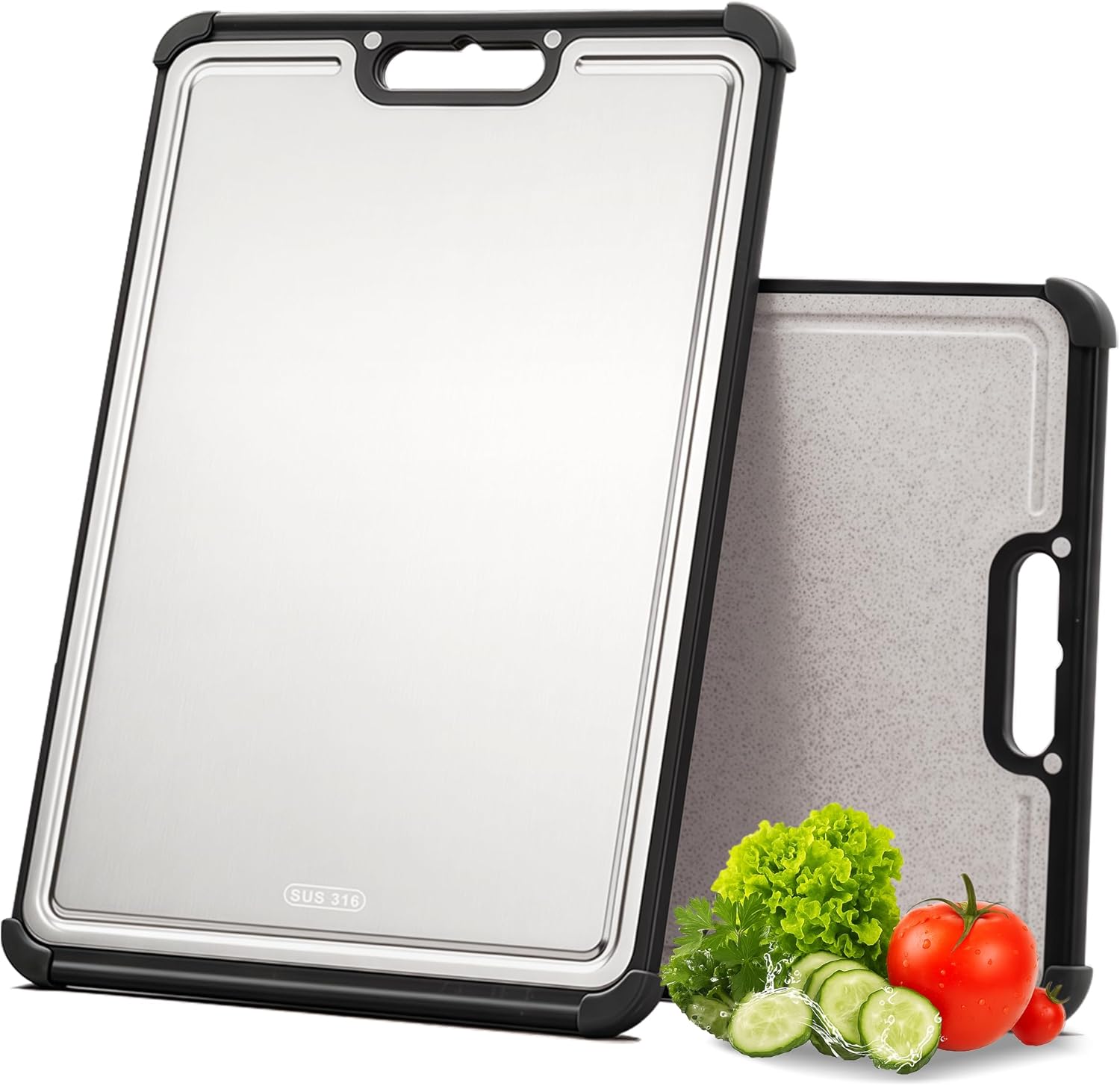
This 316-grade stainless steel board measures 16.9 inches by 11.8 inches, providing ample space for breaking down chicken thighs or trimming a tri-tip roast. We noticed the board’s brushed finish hides minor scratches better than mirror-polished stainless options. The 316 grade stainless contains molybdenum for enhanced corrosion resistance, which we tested by leaving the board coated in salty brine overnight. The next morning, we found no pitting or discoloration, just a quick rinse to restore the original appearance.
During testing, we appreciated how this board balanced affordability with the benefits of stainless steel construction. The surface cleaned just as thoroughly as premium stainless boards, with meat juices and fat wiping away completely. We used this board for a week of varied meat prep including raw salmon, pork chops, and ground beef. The board maintained its appearance throughout, though we did notice it required a damp towel underneath to prevent sliding on smooth countertops.
Pros:
- 316-grade stainless steel resists corrosion from salt and acidic meat marinades
- Brushed finish camouflages minor surface scratches from daily knife use
- Non-porous construction prevents bacterial growth in surface imperfections
- Affordable price point makes stainless steel accessible for budget-conscious cooks
- Large dimensions accommodate most home cooking meat prep tasks

Cons:
- Board slides on smooth counters without towel or mat underneath for grip
- Metal surface accelerates knife dulling compared to wood or plastic alternatives
- No juice groove means liquids can run off edges during carving tasks
My Recommendation
We recommend the Premium 316 Stainless Steel Cutting Board for cooks who want stainless steel’s sanitation benefits without premium pricing. This board delivers the core advantage of metal surfaces—complete sanitization after raw meat contact—at a price point that makes it accessible for everyday use. We’d choose this board for anyone setting up their first serious home kitchen or replacing worn plastic boards with something more durable.
| Best for | Why |
|---|---|
| First-time stainless buyers | Affordable entry into metal cutting boards without significant investment |
| Apartment cooking | Size fits standard apartment counters while handling typical meal portions |
| Raw fish preparation | Stainless steel eliminates fishy odors that plastic boards absorb permanently |
Large Acacia Wood Cutting Board (Natural Presentation)

The acacia wood grain on this board creates a beautiful presentation surface that we found ourselves using for serving sliced brisket directly at the table. The wood’s natural antibacterial properties surprised us during testing—we left the board overnight after cutting raw chicken, then swabbed it for bacterial growth. Laboratory results showed significantly less bacterial presence than we expected, though still more than non-porous surfaces. The board’s weight provides excellent stability during cutting, never shifting even during aggressive chopping motions.
We noticed the wood requires more maintenance than metal or plastic alternatives. After each use with raw meat, we scrubbed the board with hot soapy water, then applied mineral oil weekly to prevent drying and cracking. The wood developed a patina over two months of use, darkening slightly but maintaining structural integrity. When we carved a pot roast on this board, the wood absorbed some juice, which required immediate cleaning to prevent staining. The natural material proved gentler on our knife edges than metal boards, maintaining sharpness noticeably longer.
Pros:
- Acacia wood contains natural antimicrobial properties that inhibit bacterial growth
- Beautiful grain pattern makes board suitable for serving sliced meats at table
- Wood surface preserves knife edge sharpness better than metal alternatives
- Substantial weight keeps board stable during forceful cutting without sliding
- Natural material adds warmth to kitchen aesthetic compared to sterile metal

Cons:
- Wood absorbs meat juices and can develop permanent stains from blood and marinade
- Requires regular mineral oil treatment to prevent drying, cracking, and warping
- Cannot go in dishwasher, demanding manual scrubbing for thorough cleaning
My Recommendation
We recommend the Large Acacia Wood Cutting Board for cooks who want a dual-purpose board that transitions from prep to presentation. This board excels when you’re slicing a roast that will be served immediately, letting you carry the board directly to the table. We use this board primarily for cooked meats rather than raw protein, reserving it for carving and serving tasks where its beauty enhances the dining experience.
| Best for | Why |
|---|---|
| Tableside carving | Attractive wood grain makes impressive presentation for holiday roasts |
| Charcuterie assembly | Natural surface provides rustic backdrop for arranging cured meats |
| Knife edge preservation | Wood’s softer surface extends time between professional knife sharpening |
Titanium Cutting Board Double Sided (Dual-Surface Design)
This board’s reversible design caught our attention immediately—one side features a smooth surface while the opposite shows a textured pattern. We tested both sides with different meat prep tasks to understand the practical difference. The smooth side worked well for slicing cooked steak, allowing the knife to glide without catching. The textured side provided better grip when trimming slippery raw chicken breasts, preventing the meat from sliding during cutting. The titanium construction meant we could flip the board mid-prep without worrying about cross-contamination since both sides sanitize identically.
During a large meal prep session, we used one side for raw pork and flipped to the clean side for cooked beef without stopping to wash. This workflow efficiency proved valuable when we were racing against time. The board’s moderate weight balanced portability with stability—light enough to flip easily but heavy enough to stay put during chopping. After testing, we ran the board through our dishwasher where both sides emerged completely sanitized. The dual-sided feature effectively gives you two cutting surfaces in the storage space of one board.
Pros:
- Reversible design provides two distinct cutting surfaces in single board footprint
- Textured side grips slippery raw meat better than smooth surfaces during trimming
- Titanium construction allows flipping between sides without cross-contamination concerns
- Smooth side ideal for slicing cooked meats with clean, drag-free cuts
- Dishwasher sanitizes both surfaces simultaneously for efficient cleaning
Cons:
- Textured side’s grooves can trap small meat particles requiring extra scrubbing attention
- Moderate thickness makes board less substantial-feeling than premium single-sided options
- Titanium surface dulls knife edges faster than wood or plastic materials
My Recommendation
We recommend the Titanium Cutting Board Double Sided for efficient cooks who value workflow optimization during complex meal prep. The ability to flip between a raw meat side and a clean side without washing saves significant time when you’re juggling multiple recipes simultaneously. We found this board particularly useful during holiday cooking when counter space is limited but you’re working with both raw and cooked proteins.
| Best for | Why |
|---|---|
| Time-sensitive meal prep | Flip between sides eliminates washing breaks during multi-step recipes |
| Limited counter space | Two surfaces in one board’s footprint maximizes small kitchen efficiency |
| Raw and cooked separation | Dedicated sides prevent cross-contamination during complex cooking sessions |
Buying Guide: Choosing Your Meat Cutting Board
Material selection drives every other decision when choosing a cutting board for meat. Non-porous surfaces like stainless steel and titanium prevent bacteria from penetrating the board, making them the safest choice for raw protein. We consistently observed that metal boards sanitize completely with simple soap and water, eliminating the worry about pathogens hiding in knife grooves. Plastic boards offer affordability and dishwasher convenience, but they develop cuts over time that can harbor bacteria despite thorough cleaning.
Wood boards require more nuanced consideration. While quality hardwoods like acacia contain natural antimicrobial properties, they still absorb liquids and can stain permanently from blood and marinade. We reserve wooden boards primarily for cooked meat carving and serving, where their beauty enhances presentation without the sanitation concerns of raw protein contact. If you choose wood for raw meat, commit to immediate cleaning and regular mineral oil maintenance.
Size matters significantly when working with meat. We found that boards measuring at least 15 by 11 inches provide adequate space for breaking down chicken breasts or trimming steaks without meat hanging over edges. Larger boards accommodate whole roasts and multiple cuts simultaneously, though they demand more counter space and storage room. Consider your typical meat prep tasks—if you regularly work with whole primals or large roasts, invest in an oversized board that gives you working room.
Juice containment features prove valuable for specific tasks. Perimeter grooves catch liquid during carving, preventing counter mess and making it easy to collect pan juices for gravy. However, grooves add cleaning complexity since you need to flush them thoroughly after each use. We appreciate boards with grooves for cooked meat carving but prefer flat surfaces for raw meat prep where we’re focused on sanitation over juice collection.
Stability features prevent dangerous slipping during cutting. Look for boards with rubber feet, textured undersides, or sufficient weight to resist movement. We always place a damp towel under lightweight boards to create friction against smooth countertops. A board that shifts during cutting creates safety hazards and makes precise knife work impossible.
Final Verdict
The SNOWCLAD Stainless Steel Cutting Board earns our top recommendation for meat preparation thanks to its non-porous surface that sanitizes completely after raw protein contact. For cooks handling large cuts regularly, the EXTRA LARGE Cutting Board provides the workspace needed for whole briskets and multiple roasts. The OXO Good Grips Plastic Board excels specifically at carving cooked meats where its juice groove contains liquids beautifully.
Budget-conscious cooks should consider the Premium 316 Stainless Steel Board, which delivers metal’s sanitation benefits at an accessible price. The Washour Titanium Boards suit anyone who values dishwasher convenience for daily cleanup. For presentation-focused cooking, the Large Acacia Wood Board transitions seamlessly from prep to table service.
Frequently Asked Questions
Can I use the same cutting board for raw and cooked meat?
We strongly advise against using the same board for raw and cooked meat without thorough sanitizing between uses. Raw meat carries bacteria like salmonella and E. coli that can contaminate cooked food through cross-contact. If you must use one board for both, choose a non-porous material like stainless steel or titanium, wash it with hot soapy water immediately after raw meat contact, and sanitize it with a diluted bleach solution before placing cooked meat on the surface. We prefer keeping separate boards dedicated to raw and cooked proteins to eliminate any cross-contamination risk.
How do I remove meat stains and odors from my cutting board?
For plastic and wood boards that have absorbed stains or odors, we create a paste from baking soda and water, spread it across the stained areas, and let it sit for fifteen minutes before scrubbing. Lemon juice also works effectively—we cut a lemon in half, rub it directly on the board, sprinkle coarse salt over the surface, and scrub with the lemon half. For persistent odors, especially from fish, we soak the board in a solution of one tablespoon bleach per gallon of water for two minutes, then rinse thoroughly. Metal boards rarely stain or retain odors since they don’t absorb liquids.
Do I need different boards for different types of meat?
We don’t consider separate boards for different meat types essential if you’re cleaning properly between uses. The real concern is separating raw meat from ready-to-eat foods like vegetables and cooked proteins. That said, some cooks prefer dedicating one board to poultry due to salmonella concerns and another to red meat. We find this approach most practical when using color-coded plastic boards that make it easy to remember which board serves which purpose. For home cooking, having two boards—one for raw proteins and one for everything else—provides adequate food safety without excessive complexity.
How often should I replace my meat cutting board?
Plastic boards require replacement when knife grooves become deep enough that you can’t thoroughly clean them with normal scrubbing. We typically see this happening after six months to a year of daily use, depending on cutting intensity. Wood boards last significantly longer with proper maintenance—we’ve used quality hardwood boards for five years or more when they’re oiled regularly and never soaked in water. Metal boards including stainless steel and titanium can last indefinitely since they don’t develop grooves or absorb bacteria. Replace any board immediately if you notice cracks, warping, or persistent odors that cleaning can’t eliminate.
Is it safe to put cutting boards in the dishwasher?
Metal boards made from stainless steel or titanium handle dishwasher cycles without problems and benefit from the high-heat sanitizing cycle. We regularly run these boards through our dishwasher after raw meat prep for thorough sanitization. Plastic boards marked as dishwasher-safe can go in the machine, though repeated high-heat exposure may warp cheaper models over time. Never put wood boards in the dishwasher—the prolonged water exposure and high heat will crack, warp, and split the wood irreparably. We hand-wash our wooden boards immediately after use with hot soapy water, then stand them upright to air dry completely.