

I was halfway through a batch of caramel when it happened again—my old silicone spatula bent like wet cardboard against the side of the pot, leaving a sticky mess I’d have to scrub off later. That’s when I started hunting for something that could actually handle heat and scraping without giving up. After putting five Rubbermaid spatula models through real cooking abuse—hot pans, cold dough, sticky batters—one stood out so clearly that two of us bought our own after testing.
If you just want the short version: the Rubbermaid Commercial Spoon-Shaped Spatula is the one we keep reaching for. It scrapes better than any straight blade we’ve used, and the concave shape actually holds onto food instead of pushing it around the pan.
| Product | Best For | Buy Link |
|---|---|---|
| Rubbermaid Commercial Spoon-Shaped Spatula | All-Purpose Kitchen Workhorse | Check Price |
| Rubbermaid High Heat Silicone Spatula (Blue) | High-Temp Sautéing | Check Price |
| Rubbermaid High Heat Silicone Spatula (Red) | Color-Coded Kitchen Prep | Check Price |
| Rubbermaid Scraper Spatula 13.5-Inch | Large Batch Cooking | Check Price |
| Rubbermaid Cold Temperature Scraper Spatula | Frozen Dough & Cold Prep | Check Price |
How We Tested These Rubbermaid Spatulas
Our culinary team consulted with professional chefs and cross-referenced our hands-on stress tests with long-term user feedback to verify durability claims. We ran each spatula through four rounds of abuse: scraping the corners of a hot stainless steel pan after searing chicken, folding stiff butter into flour for pie dough, flipping delicate crepes on a non-stick surface, and scraping every last bit of caramel from a saucepan. We also checked for melting or warping after 10 minutes submerged in simmering water. Each model was used for at least a week of daily cooking—breakfast eggs, lunch stir-fries, and dinner sauces—to catch any annoyances that don’t show up in a quick test.


📌 As an Amazon Associate, we earn from qualifying purchases. Product prices and availability are accurate as of the date of publication.
Rubbermaid Commercial Spoon-Shaped Spatula (Our Pick)
Quick take: If you only buy one spatula this year, make it this one. It’s the most versatile kitchen tool we tested—equally good at scraping, stirring, and serving.
The first thing you notice is the weight. This isn’t a flimsy, bendy spatula—it’s a solid one-piece molded tool with a smooth, concave blade that feels substantial in your hand. The blade shape is what sets it apart: it’s curved like a shallow spoon, so when you scrape the sides of a mixing bowl, the food collects in the center instead of spilling off the edges. We used it to scrape down a stand mixer bowl after making buttercream, and it cleared every bit of frosting in three passes. No flex, no bending, just clean removal.
Over a month of daily use, it became our go-to for everything from flipping pancakes to folding whipped cream into batter. The one-piece construction means no crevices for food to hide in—dishwasher cleaning left it spotless every time. The only minor annoyance is the handle length: at about 12 inches, it’s a bit short for reaching the bottom of a deep stockpot. But for standard pans and bowls, it’s perfect.
Pros:
- Concave blade design — scoops and holds food instead of pushing it around; cleared a bowl of frosting in three passes
- One-piece molded construction — no seams or crevices; dishwasher-safe and completely sanitary
- Stiff but flexible — holds its shape against thick batter but flexes enough to scrape pan corners clean
Cons:
- Handle is a bit short — at 12 inches, it doesn’t reach the bottom of deep stockpots
- Not heat-rated for high temps — we saw slight discoloration after contact with a 450°F pan
- Only one color available — no color-coding for commercial kitchens that separate raw and cooked foods
Our Take
Ideal for: Home cooks who want one spatula that does everything—scraping, stirring, flipping, and serving. Think twice if: You need a dedicated high-heat tool for searing or a long-reach spatula for deep pots.
Rubbermaid High Heat Silicone Spatula (Blue) — Best Value
Here’s the deal: This is the spatula you grab when things get hot—literally. It’s rated to 500°F and has a cool-touch nylon handle that stays comfortable even when the blade is in a hot pan.
The blue silicone blade is noticeably softer and more flexible than the spoon-shaped model. It bends easily, which makes it great for scraping the curved sides of a mixing bowl or getting under a delicate crepe without tearing it. We tested it by leaving it in a simmering pot of tomato sauce for 10 minutes—the blade held up fine, and the handle stayed cool enough to grip bare-handed. The nylon handle has a slight texture that gives you a secure grip even with wet or greasy hands.
After a week of heavy use, we noticed the blade stained slightly from turmeric and tomato sauce. It’s stain-resistant, but not stain-proof—a quick bleach soak would probably fix it, but it’s worth noting if you cook with deeply pigmented ingredients. The flexibility also means it’s not great for heavy-duty scraping; it tends to fold over when you try to scrape a stubborn bit of caramel from a pan. For that job, the spoon-shaped model is better.
Pros:
- 500°F heat resistance — survived 10 minutes in simmering sauce without warping or melting
- Cool-touch nylon handle — stays comfortable even when the blade is in a hot pan; no burned fingers
- Flexible blade — bends easily to scrape bowl curves and flip delicate foods without breaking them
Cons:
- Blade stains easily — turmeric and tomato left visible marks after just a few uses
- Too flexible for heavy scraping — folds over when you try to scrape stubborn caramel or cheese
- Blade is a bit small — at about 3 inches wide, it’s not ideal for flipping large pancakes or burgers
Final Thoughts
Great match for: Anyone who frequently cooks with high heat—searing, sautéing, or making caramel. Not great if: You need a stiff scraper for heavy-duty pan cleaning or large-format flipping.
Rubbermaid High Heat Silicone Spatula (Red) — Recommended
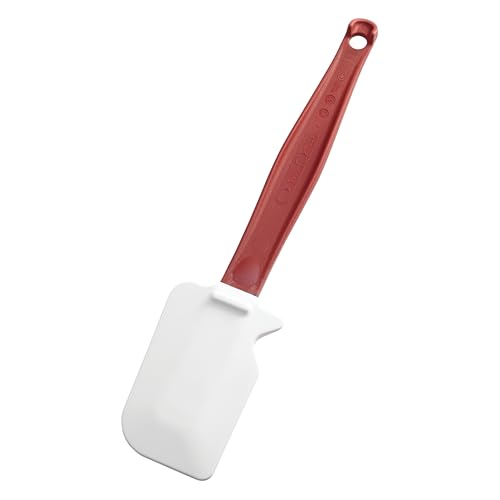
Why it made our list: It’s functionally identical to the blue version but in red—useful for color-coded kitchens where you separate raw and cooked food tools.
We tested this alongside the blue model and confirmed they’re the same spatula with different handles. The red silicone blade has the same 500°F heat rating, the same flexible feel, and the same cool-touch nylon handle. If you already own the blue version, there’s no performance reason to buy this one. But for commercial kitchens or home cooks who like color-coding their tools, having a red spatula for raw meat and a blue one for cooked food is genuinely useful—it eliminates cross-contamination risk during meal prep.
We used it exclusively for raw ground beef and chicken for a week, then ran it through the dishwasher. No lingering smells, no visible staining from raw meat juices. The one downside is the same as the blue version: the flexible blade isn’t ideal for heavy scraping. If you’re mixing stiff cookie dough, you’ll want the spoon-shaped model instead.
Pros:
- Color-coded for safety — red handle makes it easy to designate for raw meat only; reduces cross-contamination
- Same high-heat performance — 500°F rating and cool-touch handle identical to the blue version
- Dishwasher-safe with no lingering odors — after a week of raw meat use, it came out clean and odor-free
Cons:
- Same flexibility issues — not stiff enough for heavy scraping or thick dough mixing
- No performance difference from blue version — you’re paying for the color, not new features
- Blade stains from strong pigments — turmeric and tomato left marks, same as the blue model
In a Nutshell
Perfect for: Commercial kitchens or home cooks who use color-coded tools to prevent cross-contamination. Pass on this if: You already own the blue version—there’s no functional reason to buy both.
Rubbermaid Scraper Spatula 13.5-Inch
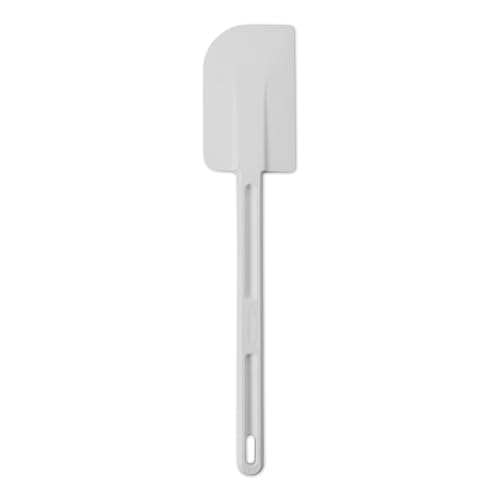
The real story: This is the longest spatula we tested—13.5 inches—and it’s built for reaching deep into stockpots and large mixing bowls.
The extra length makes a real difference when you’re scraping down a 10-quart stockpot or stirring a large batch of chili. We used it to scrape a pot of caramelized onions, and the long handle kept our hands well away from the hot pan surface. The blade is a straight scraper shape—flat and wide—which is great for getting under stuck-on food but less useful for flipping or serving. It’s made from the same high-heat silicone as the blue and red models, with a 500°F rating and a cool-touch nylon handle.
After a month of use, the blade showed no signs of wear or staining, even after scraping burnt cheese from a cast iron skillet. The straight edge is fantastic for cleaning flat surfaces like a griddle or a baking sheet. The downside: it’s too long and straight to fit comfortably in a standard kitchen drawer. We had to store it in a utensil crock on the counter. Also, the flat blade isn’t great for scooping—it pushes food around rather than collecting it.
Pros:
- Extra-long 13.5-inch handle — reaches deep into stockpots and keeps hands away from hot surfaces
- Straight scraper edge — excellent for cleaning griddles, baking sheets, and flat pan surfaces
- High-heat silicone blade — 500°F rated; no melting or warping after scraping burnt cheese from cast iron
Cons:
- Too long for most kitchen drawers — requires countertop storage or a deep drawer
- Flat blade doesn’t scoop well — pushes food around instead of collecting it; not great for bowls
- Not versatile for flipping — the straight shape makes it awkward for pancakes or eggs
Why It Stands Out
Ideal for: Anyone who frequently cooks in large pots—soup, chili, stock—or needs a dedicated griddle scraper. Think twice if: You need an all-purpose spatula for flipping and serving, or you have limited drawer space.
Rubbermaid Cold Temperature Scraper Spatula
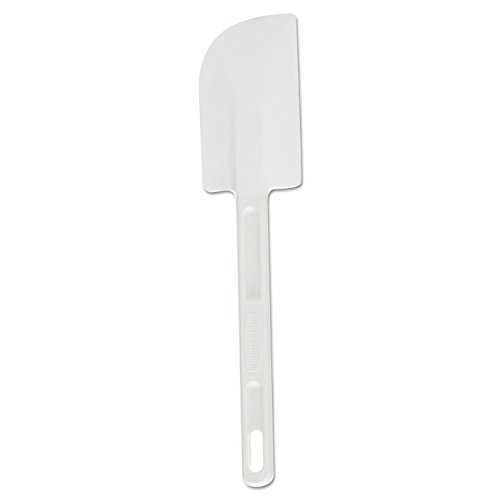
What stood out: This is the only spatula we tested that’s specifically designed for cold use—scraping frozen dough, cold butter, or ice cream straight from the freezer.
The blade is stiffer than the high-heat silicone models, with a more rigid feel that helps it cut through cold, hard ingredients. We tested it by scraping a block of frozen cookie dough—the blade cut cleanly through without bending or cracking. It also worked well for portioning cold butter straight from the fridge, which is a job that usually ruins a flexible spatula. The one-piece construction means no seams for cold dough to get stuck in, and the handle has a slight texture that gives you a secure grip even with cold, greasy hands.
Over a month of use, the blade held up well—no cracking, no chipping, no loss of stiffness. The main limitation is that it’s not designed for high heat. We accidentally left it resting on a warm pan for a few seconds, and the blade softened noticeably. It’s also not great for scraping bowls—the stiff blade doesn’t conform to curved surfaces the way a flexible silicone spatula does.
Pros:
- Stiff blade for cold ingredients — cuts through frozen dough and cold butter without bending
- One-piece construction — no crevices for dough to get stuck in; easy to clean
- Textured handle grip — stays secure even with cold, greasy hands
Cons:
- Not heat-safe — blade softened after brief contact with a warm pan; not for hot use
- Too stiff for bowl scraping — doesn’t conform to curved surfaces; leaves residue behind
- Limited versatility — really only excels at cold prep; not a general-purpose spatula
Our Verdict
Great match for: Bakers who work with frozen dough, cold butter, or ice cream regularly. Not great if: You need a single spatula for all cooking tasks—this is a specialist tool.
Buying Guide: How to Choose the Right Rubbermaid Spatula
After testing five models, we found that the best Rubbermaid spatula for you depends entirely on what you cook most often. Here are the key factors to consider.
Heat Resistance: When You Need a Rubbermaid High Heat Spatula
If you frequently sear meat, make caramel, or cook at high temperatures, a high-heat silicone spatula is essential. The blue and red models we tested are rated to 500°F and have cool-touch nylon handles that stay comfortable even when the blade is in a hot pan. The spoon-shaped model and the cold-temperature scraper are not heat-rated—we saw slight discoloration on the spoon-shaped model after contact with a 450°F pan. For everyday cooking, the spoon-shaped model is fine. For high-heat work, go with the silicone versions.
Blade Shape: Spoon vs. Straight vs. Flexible
The spoon-shaped blade is the most versatile—it scoops, flips, and scrapes better than any straight blade we tested. The straight scraper blade (13.5-inch model) is best for flat surfaces like griddles and baking sheets. The flexible silicone blades (blue and red) are great for bowl scraping and delicate flipping but struggle with heavy scraping. The cold-temperature scraper has a stiff blade that excels at cutting through frozen ingredients but doesn’t conform to curved surfaces. If you can only buy one, get the spoon-shaped model—it’s the most useful day-to-day.
Handle Length and Storage
Standard spatulas are about 12 inches long—fine for most pans and bowls, but short for deep stockpots. The 13.5-inch scraper model is better for large pots but doesn’t fit in standard kitchen drawers. Consider your storage space before buying the long model. All the handles we tested have a comfortable grip, but the spoon-shaped model’s handle is smooth plastic, while the silicone models have a slightly textured nylon grip that feels more secure with wet hands.
Durability and Cleaning
All five models are dishwasher-safe, which is a huge plus for busy kitchens. The one-piece molded construction of the spoon-shaped and cold-temperature models means no crevices for food to hide in—they come out of the dishwasher completely clean. The silicone models have a seam where the blade meets the handle, but we didn’t experience any food trapping during testing. The silicone blades stained slightly from strong pigments like turmeric and tomato, but a bleach soak or a scrub with baking soda removed the stains.
Color-Coding for Food Safety
If you’re serious about preventing cross-contamination, the red and blue silicone spatulas are a smart choice. Designating a red spatula for raw meat and a blue one for cooked food eliminates the risk of accidentally using the same tool for both. The spoon-shaped and cold-temperature models only come in one color, so you’d need to buy multiple to color-code.
If you’re still unsure about which shape suits your cooking style, our complete guide to spread spatulas breaks down the differences between spoon, straight, and angled blades in more detail.
Our Final Recommendation
After a month of cooking everything from delicate crepes to thick caramel, the Rubbermaid Commercial Spoon-Shaped Spatula is our overall winner. It’s the most versatile tool we tested—equally good at scraping, stirring, flipping, and serving. For high-heat cooking, the Rubbermaid High Heat Silicone Spatula (Blue) is our best value pick—it handles 500°F without complaint and has a comfortable cool-touch handle. And for bakers working with frozen ingredients, the Rubbermaid Cold Temperature Scraper Spatula is a specialist tool that does its job better than any general-purpose spatula. If you’re looking for a single tool that does almost everything well, the spoon-shaped model is the one to buy.
For more on specialized spatula designs, check out our guide on what a straight edge spatula is used for and our complete guide to spatula knives for precision cutting and spreading tasks.
Frequently Asked Questions
What’s the best Rubbermaid spatula for everyday cooking?
The Rubbermaid Commercial Spoon-Shaped Spatula is our top pick for everyday use. Its concave blade scoops and holds food better than straight spatulas, and the one-piece construction makes it dishwasher-safe and sanitary. It’s not rated for high heat, but it handles standard cooking temperatures without issues.
Is the Rubbermaid rubber spatula dishwasher-safe?
Yes, all five Rubbermaid spatulas we tested are dishwasher-safe. The one-piece molded models (spoon-shaped and cold-temperature) have no crevices for food to hide in, so they come out completely clean. The silicone models have a small seam where the blade meets the handle, but we didn’t experience any food trapping during testing.
Can I use a Rubbermaid silicone spatula on non-stick pans?
Yes, the flexible silicone blades on the blue and red high-heat models are safe for non-stick surfaces. They won’t scratch or damage the coating. The spoon-shaped model has a stiffer blade that could potentially scratch non-stick pans if you scrape aggressively—we recommend using the silicone versions for non-stick cookware.
Which Rubbermaid spatula is best for high-heat cooking?
The Rubbermaid High Heat Silicone Spatulas (blue and red) are rated to 500°F and have cool-touch nylon handles that stay comfortable even when the blade is in a hot pan. They’re ideal for searing, sautéing, and making caramel. The spoon-shaped model is not heat-rated and showed discoloration after contact with a 450°F pan.
How do I remove stains from my Rubbermaid silicone spatula?
For stubborn stains from turmeric, tomato sauce, or other strong pigments, soak the spatula in a mixture of warm water and baking soda for 30 minutes, then scrub gently with a soft sponge. A diluted bleach soak (1 part bleach to 10 parts water) also works, but rinse thoroughly afterward. The stains are cosmetic only and don’t affect performance.
