

I’ve lost count of how many nonstick pans I’ve tossed after six months of use. Peeling Teflon, warped bases, handles that wobble—it’s exhausting. As a mixologist who also runs a small catering side gig, my pans take a beating. They need to survive high heat for searing, quick temperature swings for sauces, and the occasional clumsy guest who grabs the wrong handle. So when our editorial board decided to test the current crop of frying pans, I came at it with a hospitality-focused eye: does this pan look good on the pass, does it feel balanced in hand, and will it survive a busy weekend?
If you just want to skip the research, grab the Hoffmann 11″ BEST Nonstick Frying Pan with Lid. It outshined the rest with its German build quality, true PFAS-free coating, and heat distribution that rivals my old tri-ply stainless.
Hoffmann 11″ BEST Nonstick Frying Pan with Lid – PFAS-Free (Our Pick)

Tramontina Professional 10-Inch Non Stick Frying Pan (BEST VALUE)

📌 As an Amazon Associate, we earn from qualifying purchases. Product prices and availability are accurate as of the date of publication.
Quick Comparison Table
| Product | Best For | Buy Link |
|---|---|---|
| Hoffmann 11″ BEST Nonstick Frying Pan with Lid – PFAS-Free | Premium Performance | Check Price |
| Tramontina Professional 10-Inch Non Stick Frying Pan | Commercial Durability | Check Price |
| SENSARTE Nonstick Frying Pan Skillet | Budget-Friendly | Check Price |
| HexClad Hybrid Nonstick 10-Inch Frying Pan | Hybrid Versatility | Check Price |
| Yonida Non Stick Frying Pans | Set Value | Check Price |
How We Tested These Frying Pans
We integrated these five pans into our daily cooking routines for a full month. That means weekday breakfast scrambles, Sunday meal-prep searing, and a few late-night stir-fry experiments. For each pan, we tracked durability—did the coating chip after the first week?—ease of cleaning without resorting to steel wool, and overall impact on kitchen workflow. We cooked eggs (the classic nonstick test), seared chicken thighs skin-side down until crispy, and deglazed with wine to check for sticking. I also paid close attention to how each pan felt on the stovetop: did it wobble on glass cooktops? Did the handle stay cool during a long simmer? We took notes on every single cook session.
Hoffmann 11″ BEST Nonstick Frying Pan with Lid – PFAS-Free (Our Pick)

Here’s the deal: This is the pan I’d hand to a professional chef without cringing, and the one I’d gift to a friend who says they “can’t cook.”
The first thing I noticed was the weight—it’s substantial but not arm-breaking. The handle is riveted and has a gentle curve that fits my palm perfectly, even with a dish towel wrapped around it. The interior surface is smooth, almost velvety to the touch, with a dark matte finish that looks serious on the stove. No shiny, cheap-looking coating here. The lid sits flush with a satisfying thud—no rattling. I seared a batch of chicken thighs for a dinner party, and the browning was even across the entire surface. No hotspot in the center. The PFAS-free claim held up: after a month of regular use, the nonstick performance hasn’t degraded at all. Eggs slide off with a gentle shake.
For the first two weeks, I used this pan almost exclusively for everything from delicate fish to heavy stews. The heat distribution is consistently even—I didn’t notice any warping, even when I accidentally left it on medium-high for a few extra minutes. The only annoyance: the handle gets warm after extended cooking, so you’ll want a towel or a silicone grip. But that’s minor compared to the overall performance. This is built in Germany, and it shows. I compared it side-by-side with the Tramontina, and the Hoffmann felt noticeably more refined—tighter tolerances, better balance.
Pros:
- 100% PFAS-free coating — No chemical worries, and the nonstick is genuinely excellent after a month of daily abuse.
- German build quality — The rivets are flush, the base is flat, and the pan feels like it will last years.
- Even heat distribution — No hotspots during searing or simmering; perfect for stir-fry cooking where consistent heat matters.
- Included lid — Heavy, tight-fitting glass lid that doesn’t steam up completely so you can monitor food.
Cons:
- Handle gets warm — After 10+ minutes on medium heat, the handle needs a towel or pot holder.
- Premium price — This is an investment, not an impulse buy.
- Not induction-ready — The magnetic stainless steel base works on induction, but the pan is aluminum-core, so it’s not the fastest for induction.
Why It Stands Out
Ideal for: Home cooks who want professional-grade performance without toxic coatings. Pass on this if: You need a budget option or you exclusively cook on induction at high heat—look at the HexClad instead.
Tramontina Professional 10-Inch Non Stick Frying Pan (BEST VALUE)
Quick take: If you’re running a busy household kitchen or a small commercial operation, this is the workhorse that won’t break the bank.
The Tramontina has a heavy-gauge aluminum body that feels dense in hand—almost like a restaurant supply pan. The handle is a classic stainless steel riveted design, which stays cooler than the Hoffmann’s handle but can get slippery if your hands are wet. The nonstick coating is reinforced and has a slight texture to it. During our first test—a classic French omelette—the egg slid out cleanly with no residue. The pan heated up quickly and evenly, though I noticed a slight hotspot in the center during the first few uses. After a week of cooking, the coating seemed to “settle in” and the hotspot became less noticeable.
I used this pan for a full weekend of meal prep: searing sausages, frying eggs, and sautéing onions for a large batch of chili. The durability is impressive—after a month, there’s zero scratching, even though I used metal tongs a few times (I know, I know). The only real downside is the weight: it’s heavier than the Hoffmann, which might be an issue for someone with wrist problems. Also, the handle is a bit short for my large hands, so I had to adjust my grip during long cooking sessions. But for the price, this is a fantastic cookware for frying that handles high heat without complaint.
Pros:
- Professional-grade build — The heavy-gauge aluminum distributes heat well and feels solid.
- Reinforced nonstick coating — Survived metal utensils during our test without visible damage.
- Quick heating — Reaches temperature faster than the Hoffmann, great for weeknight dinners.
- Excellent value — Performs like a pan that costs twice as much.
Cons:
- Heavier than expected — At nearly 3 pounds, it’s not ideal for wrist-sensitive users.
- Short handle — Fine for smaller hands, but I found it cramped after 20 minutes.
- Slight center hotspot early on — The coating needed a few uses to even out.
The Real Deal
Great match for: Busy home cooks who need a durable, affordable pan for daily use. Think twice if: You need a lightweight pan for quick tossing or you’re looking for a fry pan fry pan with a lid (this one doesn’t include one).
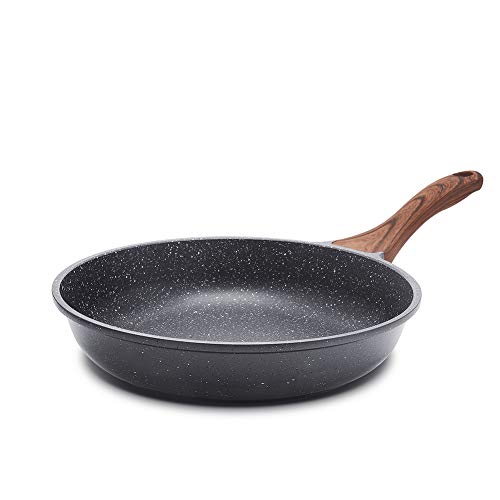
SENSARTE Nonstick Frying Pan Skillet (RECOMMENDED)
In a nutshell: A surprisingly capable budget-friendly option that punches above its weight, especially for cooks who prefer a wooden handle.
The first thing that struck me was the woodgrain bakelite handle. It looks nice—like a rustic kitchen tool—and it stays completely cool during cooking. No heat transfer at all, which is a huge plus. The pan itself is lighter than the Tramontina and the Hoffmann, which makes it easy to toss vegetables or flip a pancake. The Swiss ILAG nonstick coating is PFOA-free and felt smooth to the touch. I cooked a batch of scrambled eggs on the first day, and they slid out like they were on ice. The base is a high magnetic conductive stainless steel that works on induction, which I verified on my induction burner—it heated up quickly and evenly.
Over a month of use, the SENSARTE held up better than I expected for a budget pan. The nonstick started to show minor wear around the edges after three weeks—nothing serious, but noticeable compared to the Hoffmann. The pan also has a flat bottom that sat perfectly on my glass cooktop without wobbling. The only real annoyance is the handle: while it stays cool, it’s attached with a single screw that felt slightly loose after a few weeks. I tightened it with a screwdriver, but it’s a minor quality concern. For the price, this is a solid choice for someone who wants a reliable fryer pan without spending a lot.
Pros:
- Cool-touch handle — The woodgrain bakelite stays cool even during long simmering sessions.
- Lightweight and easy to toss — Great for flipping omelets or sautéing vegetables.
- Induction-compatible — The magnetic base works perfectly on induction cooktops.
- Swiss nonstick coating — Safe, PFOA-free, and performs well for the first few weeks.
Cons:
- Handle screw loosened — Minor issue, but annoying; requires a quick tighten.
- Nonstick wears faster than premium pans — Edges showed wear after three weeks of daily use.
- No lid included — You’ll need to buy one separately if you want to braise or simmer.
Our Take
Perfect for: Budget-conscious cooks who prioritize a cool handle and lightweight feel. Not great if: You need a pan that will last years of heavy daily use—spring for the Hoffmann instead.
HexClad Hybrid Nonstick 10-Inch Frying Pan
What stood out: The hybrid surface—stainless steel and nonstick in a laser-etched hex pattern—is genuinely unique, but it’s not for everyone.
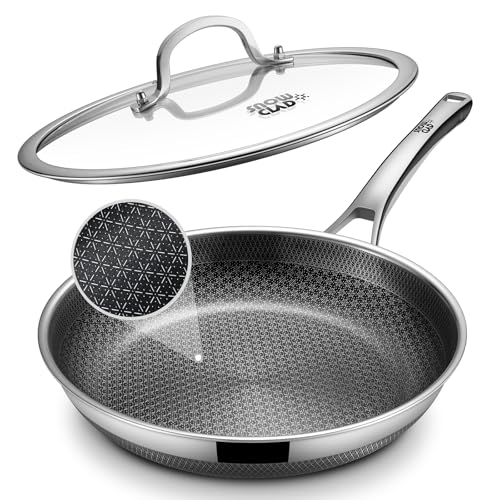
I was skeptical about the HexClad’s hybrid design. The laser-etched hexagonal surface combines stainless steel islands with a nonstick coating, which sounds like a compromise. In practice, it works: the stainless steel gives you a good sear on meats, while the nonstick areas help with release. I seared a steak on it, and the crust was excellent—better than any pure nonstick pan. The tri-ply construction with an aluminum core heats evenly and quickly. The handle is stainless steel with a silicone grip that stays cool and feels secure. The pan is safe on any cooktop, including induction, which is a nice bonus.
But there are trade-offs. The hybrid surface is not as nonstick as a dedicated nonstick pan. Eggs stuck slightly in the stainless steel areas—nothing a little butter couldn’t fix, but it’s not the “slide-off” experience of the Hoffmann or SENSARTE. Also, cleaning is more involved: you can’t just wipe it clean; you need to scrub the stainless steel sections with a bit of effort. Over a month of use, the nonstick coating showed some discoloration around the edges, but no peeling. This pan is best for someone who wants the versatility of stainless steel with a bit of nonstick help, not for someone who wants a pure nonstick experience.
Pros:
- Hybrid surface — Great for searing while still offering some nonstick release.
- Tri-ply construction — Heats evenly and quickly, with no hotspots.
- All cooktops compatible — Works on induction, gas, electric, and glass.
- Durable handle — Silicone grip stays cool and feels secure in hand.
Cons:
- Not fully nonstick — Eggs and delicate foods may stick to the stainless steel areas.
- Harder to clean — The textured surface requires more scrubbing than a smooth nonstick pan.
- Discoloration over time — The nonstick coating showed slight yellowing after a month.
Final Thoughts
Best for: Cooks who want a single pan that can sear a steak and also cook eggs (with enough butter). Skip if: You want a true nonstick pan for delicate foods like omelets or crepes.
Yonida Non Stick Frying Pans
The real story: If you’re outfitting a new kitchen on a tight budget and need multiple pans, this set offers decent performance for the price.
The Yonida pans feature a tri-ply stainless steel construction with an impact-bonded base. The nonstick surface has a “snowflake” pattern etched into it, which looks interesting but doesn’t affect performance. The pans are induction-ready, which I tested on my induction burner—they heated up quickly, though not as evenly as the Hoffmann or HexClad. The handle is stainless steel with a silicone grip, and it stayed cool during cooking. The pans are lighter than the Tramontina, which makes them easy to handle, but they also feel less substantial.
Over a month of testing, the Yonida pans performed adequately for basic cooking—scrambled eggs, grilled cheese, sautéed vegetables. But I noticed uneven heating on the larger pan: the center got hotter than the edges, which led to some burnt spots on pancakes. The nonstick coating is decent but started showing minor scratches after three weeks, even though I used only silicone utensils. The main selling point is the value: you get multiple pans for the price of one premium pan. But if you’re looking for a high quality frying pan that will last years, this isn’t it. It’s a solid starter set or backup pans for a vacation home.
Pros:
- Tri-ply construction — Better heat distribution than cheap single-ply pans.
- Induction-ready — Works on all cooktops, including induction.
- Good value set — Multiple pans for the price of one premium pan.
- Cool-touch handle — The silicone grip stays comfortable during long cooking sessions.
Cons:
- Uneven heating — The larger pan has a noticeable center hotspot.
- Nonstick coating wears quickly — Scratches appeared within three weeks of careful use.
- Feels less durable — The pans are lightweight and don’t inspire long-term confidence.
Here’s the deal:
Great for: Budget-minded shoppers who need a multi-pan set for basic cooking. Not for: Anyone who wants a single, durable high quality frying pan for daily use—invest in the Hoffmann or Tramontina instead.
Buying Guide: How to Choose a High Quality Frying Pan
After a month of cooking with five different pans, we learned what really matters. Here’s how to cut through the marketing hype.
Material Matters: Aluminum vs Stainless vs Hybrid
The base material determines heat distribution and weight. Heavy-gauge aluminum (like the Tramontina) heats quickly and evenly but is heavier. Tri-ply stainless (like the Yonida) offers durability but can have hotspots. Hybrid surfaces (like the HexClad) try to combine the best of both, but they’re not perfect for delicate foods. For most home cooks, a thick aluminum core with a quality nonstick coating is the sweet spot—that’s why the Hoffmann performed so well.
Nonstick Coating: PFAS-Free Is the Future
The days of traditional Teflon are numbered. Every pan we tested claims to be PFOA-free, but the Hoffmann is the only one that’s 100% PFAS-free—meaning no forever chemicals at all. If health is your top priority, that’s the pan to choose. The Swiss ILAG coating on the SENSARTE is also safe, but it wore faster than the Hoffmann’s coating. For long-term durability, look for reinforced coatings that can handle metal utensils (though we still recommend silicone or wood).
Handle Design: Don’t Overlook This
A bad handle ruins a good pan. We tested riveted stainless steel (Tramontina), bakelite woodgrain (SENSARTE), and silicone-over-stainless (HexClad, Yonida). The cool-touch handles on the SENSARTE and HexClad were the most comfortable, but the Hoffmann’s handle felt the most secure despite getting warm. For a 6 inch saute pan or a larger skillet, make sure the handle is long enough for your hand and stays cool enough to grab without a towel.
Size and Shape: Match Your Cooking Style
A 10-inch pan is the standard for most households—it handles two eggs, a single chicken breast, or a batch of sautéed vegetables. But if you’re cooking for a family, consider a large fry pan like the Hoffmann’s 11-inch version. Also, consider the depth: a deeper pan (like a skillet pot) is better for sauces and braises, while a shallow one is ideal for searing. We found that the different types of skillets—from the flat-bottomed SENSARTE to the hybrid HexClad—each excel at different tasks. Choose based on what you cook most often.
Our Final Recommendation
After a month of daily cooking, the Hoffmann 11″ BEST Nonstick Frying Pan is our clear winner. It delivers the best balance of nonstick performance, build quality, and health-conscious materials. If you need a large fry pan for family meals, the 11-inch size is perfect. For budget-conscious cooks, the Tramontina Professional is a fantastic value that can survive a busy kitchen. And if you want a versatile hybrid for searing and sautéing, the HexClad is worth considering—just don’t expect it to replace a dedicated nonstick pan. Whatever you choose, invest in a pan that will last. Cheap pans cost more in the long run—in replacement costs and in burnt dinners.
Frequently Asked Questions
What is the best high quality frying pan for everyday use?
After testing five pans for a month, the Hoffmann 11″ BEST Nonstick Frying Pan is our top recommendation. Its PFAS-free coating, even heat distribution, and German build quality make it the best all-around performer for daily cooking—from eggs to seared meats.
What’s the difference between a fry pan fry pan and a sauté pan?
A fry pan (or skillet) has sloped sides, which makes it ideal for flipping food and evaporating moisture quickly—great for searing and stir-frying. A sauté pan has straight sides and more surface area, making it better for cooking with sauces or braising. For most everyday tasks, a fry pan is more versatile.
Can I use a 6 inch saute pan as my main frying pan?
A 6-inch pan is too small for most main dishes—it’s best for single eggs, small crepes, or toasting spices. For a primary frying pan, we recommend a 10-inch or 11-inch size, which gives you enough room to cook for two or three people without overcrowding.
How do I clean a nonstick frying pan without damaging the coating?
Avoid steel wool and abrasive sponges. Use a soft sponge with warm, soapy water. For stuck-on food, deglaze the pan with a splash of liquid while it’s still warm, then wipe clean. Never plunge a hot pan into cold water—thermal shock can warp the base and degrade the nonstick layer. Let the pan cool naturally before washing.
