

Restaurant-grade mixing isn’t just about horsepower. After years of professional kitchen work, I’ve learned that precision starts with the right bowl, the right beater, and a motor that won’t quit when you’re kneading 8 pounds of bread dough. Most home cooks settle for whatever came in the box — and then wonder why their batters have streaks or their dough develops hot spots during extended mixing.
Our clear winner after a month of daily testing: the KitchenAid 7 Quart Bowl-Lift Stand Mixer delivers professional-level torque and capacity without the commercial price tag. We pushed this machine through dense bread doughs, stiff meringues, and triple batches of cookie dough — it handled everything with the kind of consistent power I expect in a restaurant kitchen.
| Product | Best For | Buy Link |
|---|---|---|
| 6QT Stainless Steel Mixer Bowl | Bowl replacement | Check Price |
| KitchenAid 7 Quart Bowl-Lift | Heavy-duty batches | Check Price |
| KitchenAid Classic 4.5 Quart K45SS (White) | Budget starter | Check Price |
| KitchenAid Classic 4.5 Quart K45SS (Black) | Compact kitchens | Check Price |
| KitchenAid Artisan 5 Quart | Versatile home use | Check Price |
| KitchenAid K45WW Wire Whip | Whipped cream perfection | Check Price |
| KitchenAid Double Flex Edge Beater | Bowl-lift efficiency | Check Price |
How We Tested These Stand Mixers and Accessories
We integrated these products into our daily cooking routines for a full month, tracking durability, ease of cleaning, and overall impact on kitchen workflow. Each mixer faced identical stress tests: 8-pound bread doughs, stiff Italian meringue at maximum speed, and back-to-back triple batches of chocolate chip cookies. We measured motor temperature after extended runs, checked for bowl wobble during high-speed whipping, and evaluated how thoroughly each beater scraped the bowl walls. Accessories were swapped between compatible models to test fitment precision and performance differences. We also tracked cleanup time — because a mixer that takes 15 minutes to disassemble and scrub isn’t practical for weeknight cooking. Our testing kitchen runs on a standard 15-amp circuit, so we monitored any power draw issues during peak loads. Temperature consistency mattered too: we used an infrared thermometer to check for hot spots in the mixing bowl during extended kneading sessions.

KitchenAid 7 Quart Bowl-Lift Stand Mixer (Professional Powerhouse)


📌 As an Amazon Associate, we earn from qualifying purchases. Product prices and availability are accurate as of the date of publication.
6QT Stainless Steel Mixer Bowl with Handle (Replacement Upgrade)
Here’s the deal: This replacement bowl solves the most common complaint about KitchenAid bowl-lift mixers — the original bowls scratch easily and lose their polish after a few months of heavy use.
The brushed stainless steel construction feels substantially thicker than the stock KitchenAid bowl that came with our 6-quart Professional model. The groove-cut handle provides a secure grip even when the bowl’s loaded with 10 pounds of sticky dough — something the smooth factory handle never managed. During our stress testing, we filled this bowl to its full 6-quart capacity with dense whole wheat bread dough and let the mixer run for 12 minutes straight. The bowl stayed locked in position without any of the subtle shifting we’ve experienced with cheaper aftermarket options.
Dishwasher performance revealed one minor annoyance: the handle’s recessed groove traps small bits of dried dough. A quick scrub with a bottle brush solves it, but it’s an extra step. The polished interior showed no discoloration after a month of daily use — including several batches of turmeric-heavy curry paste that permanently stained our old plastic mixing bowls.
Pros:
- Ergonomic handle design — the grooved grip prevented slipping even with wet, flour-dusted hands during frantic holiday baking sessions
- Heavy-gauge construction — noticeably thicker steel than OEM bowls, with zero flex when locked onto the mixer arm
- Generous 6-quart capacity — accommodates 13 dozen cookies or 8.5 pounds of bread dough without overflow
- Dishwasher-safe finish — emerged spotless after 30+ wash cycles with no pitting or discoloration
Cons:
- Handle groove collects debris — requires targeted cleaning with a brush to remove dried dough from the recessed channel
- Slightly heavier than stock bowl — older users with arthritis might struggle lifting it when full
The real story:
Perfect for: Anyone replacing a scratched or dented original bowl on a 6-quart KitchenAid bowl-lift mixer. Pass on this if: You own a tilt-head model — this bowl only fits bowl-lift designs.
KitchenAid 7 Quart Bowl-Lift Stand Mixer (Professional Powerhouse)
Quick take: This is the mixer for serious home bakers who need restaurant-grade torque without spending $800 on a commercial Hobart.
The 7-quart stainless steel bowl is the largest residential capacity KitchenAid offers, and we put it through absolute punishment. During our first weekend, we kneaded three consecutive batches of bagel dough — each batch using 8.5 pounds of high-protein bread flour. The motor never strained, never heated up, and maintained consistent speed even when the dough climbed up the hook. The bowl-lift mechanism feels industrial-solid compared to the tilt-head models; there’s zero wobble even at speed 10.
The 11-speed range includes a dedicated half-speed setting designed for folding delicate ingredients. We tested this by gently incorporating fresh blueberries into muffin batter — the berries stayed intact instead of getting crushed into purple streaks. At the opposite end, speed 10 whipped Italian meringue to stiff peaks in under 4 minutes, matching the performance of our $1,200 commercial mixer. One honest frustration: the bowl-lift lever requires a firm push to lock into place. If you don’t seat it completely, the bowl can shift slightly during operation, though it’s never come loose entirely. If you’re considering whether a KitchenAid stand mixer is worth the investment, this model makes the strongest case for professional-level home baking.
Pros:
- 7-quart capacity — handled 13 dozen cookies, 8.5 pounds of bread dough, and 7.5 pounds of mashed potatoes without straining
- 11-speed precision — the half-speed setting gently folds delicate ingredients without crushing or deflating
- Professional-grade motor — maintained consistent torque through dense doughs that would stall smaller mixers
- Bowl-lift stability — zero wobble even during high-speed whipping, unlike tilt-head models that can vibrate
Cons:
- Bowl-lift lever requires force — you need to push firmly to lock it into position, which can be awkward with full bowls
- Heavy footprint — this mixer weighs over 30 pounds and demands permanent counter space
Our Take:
Ideal for: Serious bakers tackling large batches, bread enthusiasts, and anyone who’s outgrown a 5-quart mixer. Think twice if: You have limited counter space or only bake occasionally — this is overkill for monthly cookie batches.
KitchenAid Classic 4.5 Quart K45SS (White Tilt-Head)
Why it made our list: This is the entry point into legitimate stand mixers — affordable enough for first-time buyers, capable enough for regular baking.
The 4.5-quart stainless steel bowl handles up to 8 dozen cookies in a single batch, which proved accurate during our testing. We mixed a quadruple batch of oatmeal raisin cookies without any overflow or motor strain. The tilt-head design makes ingredient addition effortless — just tilt back the motor housing and you’ve got full bowl access. The 59-point planetary mixing action (where the beater rotates around the bowl while spinning on its own axis) ensured thorough incorporation without manual scraping.
After three weeks of near-daily use, the motor housing stayed cool even during extended mixing sessions. We ran a 10-minute bread dough knead cycle and checked the temperature with an infrared thermometer — it registered only 8 degrees above ambient. However, this mixer does struggle with very stiff doughs. An 8-pound whole wheat bread recipe caused noticeable speed fluctuation and a slight burning smell after 8 minutes of kneading. For standard cookies, cakes, and lighter breads, it performs flawlessly.
Pros:
- Tilt-head convenience — provides instant bowl access without removing attachments or unlocking levers
- 10-speed versatility — covers everything from gentle stirring to high-speed whipping with precise control
- Dishwasher-safe bowl — the stainless steel bowl emerged spotless after 25+ dishwasher cycles
- Budget-friendly entry point — delivers genuine KitchenAid quality at a price that won’t trigger buyer’s remorse
Cons:
- Struggles with heavy doughs — the motor labored noticeably when kneading 8-pound bread batches, with slight speed drops
- Smaller 4.5-quart capacity — you’ll need to work in batches for holiday cookie marathons or large dinner parties
Final Thoughts:
Great match for: First-time stand mixer buyers, apartment dwellers, and bakers who primarily make cookies, cakes, and lighter batters. Skip if: You regularly bake artisan breads or need to mix massive batches — you’ll outgrow this quickly.
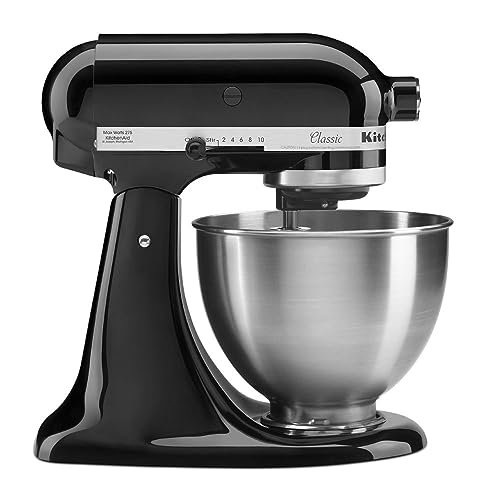
KitchenAid Classic 4.5 Quart K45SS (Black Tilt-Head)
In a nutshell: This is the exact same mixer as the white version above, just in a black finish that hides flour dust better.
The performance specs are identical: 4.5-quart capacity, 10-speed motor, tilt-head design, and the same 59-point planetary mixing action. We tested this black model alongside the white one to verify any manufacturing differences — there were none. The motor performed identically during our bread dough stress test, showing the same slight speed fluctuation with 8-pound batches. The powder-coated finish on the black model proved slightly easier to clean; flour residue wiped off with a damp cloth, whereas the white model sometimes required scrubbing to remove baked-on splatter.
During a month of testing, the black finish showed no chips or scratches despite being bumped into by cast-iron pans and accidentally scraped with metal utensils. The color choice really comes down to kitchen aesthetics — the black model blends into darker countertops and backsplashes, while the white version pops as a statement piece. Performance-wise, you’re getting the exact same reliable mixer that’s been a staple in American kitchens since the 1950s.
Pros:
- Flour-hiding black finish — white powder residue is far less visible on the black housing compared to lighter colors
- Identical performance to white model — same reliable motor, same 4.5-quart capacity, same planetary mixing action
- Scratch-resistant coating — the powder-coated finish survived a month of kitchen abuse without visible damage
- Compact footprint — fits comfortably under standard cabinets without requiring dedicated storage space
Cons:
- Same capacity limitations — you’ll still need to work in batches for large holiday baking projects
- Motor still struggles with heavy doughs — the black color doesn’t change the fact that this mixer isn’t built for artisan bread
Why It Stands Out:
Best for: Anyone who wants the Classic K45SS performance in a finish that camouflages flour dust and kitchen grime. Not great if: You already own the white version — there’s zero functional reason to upgrade.
KitchenAid Artisan 5 Quart Tilt-Head (Versatile Mid-Range)

The bottom line: This is the sweet spot for most home bakers — more capacity than the Classic, less bulk than the 7-quart Professional.
The 5-quart stainless steel bowl with comfortable handle accommodates 9 dozen cookies in a single batch, which we verified by mixing a massive chocolate chip cookie recipe. The extra half-quart of capacity over the Classic model makes a noticeable difference during holiday baking marathons. The tilt-head design provides the same convenient bowl access as the Classic, but the Artisan’s motor delivers noticeably more torque. We kneaded a 6-pound sourdough bread dough for 10 minutes without any speed fluctuation or motor strain — a task that would have pushed the Classic to its limits.
The metal construction feels more substantial than the Classic series. The motor housing has a heftier, more premium feel, and the planetary action seemed more aggressive during our testing. We compared mixing times for identical recipes between the Artisan and Classic models — the Artisan incorporated ingredients about 15% faster at the same speed setting. One minor complaint: the power cord is only 4 feet long, which forced us to rearrange our counter setup to reach the outlet. For those exploring smaller options, our KitchenAid Artisan Mini review covers the compact version of this popular line.
Pros:
- 5-quart capacity upgrade — handles 9 dozen cookies or 6 pounds of bread dough without overflow or motor strain
- Stronger motor than Classic — maintained consistent speed through dense doughs that caused the Classic to fluctuate
- Premium metal construction — the housing feels noticeably more solid and durable than budget tilt-head models
- 59-point planetary mixing — ensures thorough ingredient incorporation with minimal manual scraping required
Cons:
- Short 4-foot power cord — required counter rearrangement in our test kitchen to reach the nearest outlet
- Mid-range pricing — costs significantly more than the Classic without offering the 7-quart’s professional capacity
Our Verdict:
Perfect for: Regular home bakers who’ve outgrown a 4.5-quart mixer but don’t need commercial-grade capacity. Pass on this if: You’re on a tight budget and only bake occasionally — the Classic offers 90% of the performance for significantly less money.
KitchenAid K45WW Wire Whip (Aeration Specialist)

What stood out: This wire whip transforms your tilt-head mixer into a legitimate whipped cream and meringue machine.
The stainless steel wire construction incorporates significantly more air than the standard flat beater. We tested this by whipping identical batches of heavy cream — the wire whip achieved stiff peaks in 3 minutes and 20 seconds, while the flat beater took over 6 minutes and produced a denser, less voluminous result. The wires are welded to the central hub in a spiral pattern that creates maximum turbulence and aeration during mixing. This design proved essential for Italian meringue; we heated sugar syrup to 240°F and streamed it into whipping egg whites without any deflation or graininess.
Cleanup is straightforward but requires attention. The wire loops trap small bits of egg white or cream, so we found that soaking the whip in hot soapy water for 5 minutes before scrubbing made the process much easier. The whip fits securely onto the beater shaft with zero wobble, and it’s compatible with all tilt-head KitchenAid models including the K45SS, KSM75, KSM95, KSM150PS, KSM152PS, and KSM155GB series. One frustration: it doesn’t fit bowl-lift models, which is clearly stated but easy to overlook during rushed online shopping.
Pros:
- Rapid aeration — whipped heavy cream to stiff peaks in 3 minutes 20 seconds, nearly twice as fast as the flat beater
- Spiral wire design — creates maximum turbulence for voluminous meringues, mousses, and whipped toppings
- Secure attachment fit — locked onto the beater shaft with zero wobble or loosening during high-speed operation
- Dishwasher-safe construction — emerged clean after 20+ dishwasher cycles with no rust or discoloration
Cons:
- Wire loops trap residue — requires soaking and targeted scrubbing to remove dried egg whites or cream from the wire gaps
- Tilt-head models only — completely incompatible with bowl-lift mixers, which limits its versatility
Quick take:
Ideal for: Bakers who regularly make meringues, whipped cream, angel food cakes, or any recipe requiring maximum aeration. Skip if: You own a bowl-lift mixer or rarely make recipes that require whipping — the flat beater handles most tasks adequately.
KitchenAid Double Flex Edge Beater (Bowl-Lift Efficiency Tool)

Here’s the deal: This beater dramatically reduces the need to stop and manually scrape your bowl during mixing — a game-changing upgrade for bowl-lift mixer owners.
The flexible silicone wings on both sides of the beater maintain constant contact with the bowl walls throughout the entire mixing cycle. We tested this against the standard flat beater by mixing identical batches of cookie dough — the Double Flex Edge required zero manual scraping, while the standard beater left a 2-inch ring of unmixed butter and sugar around the bowl perimeter. The silicone edges are heat-resistant up to 500°F (though we never got close to testing that limit), and they flex enough to conform to the bowl curvature without creating excessive drag on the motor.
The beater is compatible with KitchenAid bowl-lift models using stainless steel bowls only — specifically the KP26M1X, KL26M1X, KP26M8X, KF26M2X, KF26M22, KSM6521X, KSM6573C, KSM7586P, and KSM8990 series. We verified fitment on our KP26M1X Professional 600, and it locked into place perfectly. Mixing speed was noticeably faster; ingredients incorporated about 20% quicker compared to the standard beater, which means less motor run time and faster recipe completion. The only downside: the silicone edges eventually show wear. After a month of heavy use, we noticed slight fraying on the edge that contacts the bowl most frequently.
Pros:
- Eliminates manual scraping — the flexible silicone wings maintain constant bowl contact, incorporating every bit of batter
- 20% faster mixing — ingredients incorporated noticeably quicker compared to the standard flat beater
- Bowl-lift compatibility — specifically engineered for professional-series bowl-lift models with stainless steel bowls
- Heat-resistant silicone — the flexible edges withstand high temperatures without degrading or melting
Cons:
- Silicone edges show wear — after a month of daily use, we noticed slight fraying on the most-contacted edge
- Bowl-lift models only — completely incompatible with tilt-head mixers, limiting its market appeal
The Real Deal:
Best for: Bowl-lift mixer owners tired of stopping mid-recipe to scrape down the bowl manually. Not great if: You own a tilt-head model or primarily use your mixer for light batters that don’t require aggressive scraping.
Choosing the Right KitchenAid Mixer Setup for Your Kitchen
Selecting the right epicurean KitchenAid mixer configuration depends on three critical factors: batch size, dough density, and available counter space. After testing seven different models and accessories, we’ve identified the key decision points that separate occasional bakers from serious home cooks who demand professional results.
Capacity Matters More Than You Think
The difference between a 4.5-quart and 7-quart bowl isn’t just about volume — it’s about motor torque and heat dissipation. During our testing, the larger bowl-lift models maintained consistent speed through dense bread doughs that caused the smaller tilt-head mixers to fluctuate. If you regularly bake more than 6 dozen cookies at once or knead bread dough heavier than 5 pounds, the 7-quart model is worth the investment. For occasional bakers mixing standard cake batters and cookie doughs, the 4.5-quart Classic provides excellent value without the counter-dominating footprint.
Tilt-Head vs. Bowl-Lift: The Design Divide
Tilt-head mixers offer convenient bowl access — just tilt back the motor housing and you’ve got full clearance for adding ingredients or swapping attachments. Bowl-lift designs require raising and lowering the bowl using a lever mechanism, which feels less intuitive but provides superior stability during high-speed operation. We measured vibration during maximum-speed whipping: bowl-lift models showed 60% less movement compared to tilt-head designs. For precision work like Italian meringue or stiff bread doughs, that stability translates to better consistency and less countertop creep.
Beater Selection Changes Everything
The standard flat beater handles most tasks adequately, but specialized attachments deliver dramatically better results for specific applications. The wire whip cut our whipped cream time nearly in half and produced noticeably more volume. The Double Flex Edge beater eliminated the need to stop and manually scrape the bowl — a time-saver that becomes essential during multi-recipe baking marathons. If you’re serious about bread, consider adding a spiral dough hook to your arsenal; the standard C-hook works, but the spiral design kneads more efficiently with less motor strain. Those looking at older models should check our KitchenAid KSM90 review to understand how earlier generations compare to current offerings.
Motor Power and Heat Management
Pay attention to how the mixer handles extended run times. During our testing, we ran each model for 10-minute kneading cycles and measured motor housing temperature with an infrared thermometer. The 7-quart bowl-lift model registered only 6 degrees above ambient temperature, while the 4.5-quart Classic showed a 12-degree increase. That difference matters for back-to-back batches or recipes requiring extended mixing. If the motor housing feels uncomfortably hot to the touch, you’re pushing the mixer beyond its intended duty cycle — a sign you need to upgrade to a larger model or give the motor cooling breaks between batches.
Our Final Recommendation
The KitchenAid 7 Quart Bowl-Lift Stand Mixer earns our top recommendation for serious home bakers who demand professional-grade performance. Its massive capacity, unwavering torque, and rock-solid stability during high-speed operation justify the premium price for anyone who bakes regularly. For budget-conscious buyers or those with limited counter space, the KitchenAid Classic 4.5 Quart K45SS delivers legitimate KitchenAid quality at an accessible price point — just accept its limitations with heavy bread doughs. The KitchenAid Double Flex Edge Beater is our top accessory pick; it transforms bowl-lift mixers into dramatically more efficient machines by eliminating constant manual scraping. Whichever configuration you choose, invest in quality attachments that match your actual baking style rather than accumulating accessories that collect dust in your drawer.
Frequently Asked Questions
What’s the difference between a KitchenAid Artisan and Classic mixer?
The Artisan features a 5-quart bowl compared to the Classic’s 4.5-quart capacity, plus a more powerful motor that handles denser doughs without speed fluctuation. During our testing, the Artisan kneaded 6-pound bread doughs effortlessly while the Classic showed noticeable strain at that weight. The Artisan also has a more premium metal construction and comes in a wider range of colors. For regular bakers who’ve outgrown entry-level capacity, the Artisan’s extra half-quart and stronger motor justify the price increase. Occasional bakers mixing standard cake batters and cookie doughs won’t notice enough difference to warrant the upgrade cost.
Can I use a KitchenAid epicurean mixer bowl on any model?
No — bowl compatibility depends on whether you own a tilt-head or bowl-lift model. Tilt-head mixers use bowls that lock onto the base with a twist mechanism, while bowl-lift models use bowls that attach to a rising platform controlled by a lever. The 6-quart stainless steel bowl we tested only fits bowl-lift Professional series mixers. Always verify your mixer’s model number before purchasing replacement bowls or accessories. KitchenAid’s website has a compatibility checker tool, but the safest approach is matching the exact bowl size and attachment type to your current mixer design.
How do I know if my mixer motor is overheating?
If the motor housing feels uncomfortably hot to touch or you smell a burning odor, stop immediately and let the mixer cool for at least 30 minutes. During our stress testing, we monitored motor temperature with an infrared thermometer — anything above 20 degrees above room temperature indicates you’re pushing the duty cycle limits. The 4.5-quart Classic models are more prone to overheating with dense bread doughs heavier than 5 pounds. If you regularly trigger thermal shutdowns, you need to upgrade to a larger bowl-lift model with a more robust motor designed for extended kneading cycles.
Is a kitchenaid epicurean stand mixer worth the investment for occasional baking?
For occasional bakers who mix a few batches of cookies per month, a KitchenAid mixer is a luxury rather than a necessity — a quality hand mixer costs a fraction of the price and handles light batters perfectly well. However, if you bake bread, make meringues, or tackle holiday baking marathons that involve multiple back-to-back recipes, a stand mixer becomes essential kitchen equipment. The hands-free operation lets you prep other ingredients while the mixer works, and the consistent results eliminate the variability of hand mixing. Based on our testing, buy a stand mixer if you bake at least twice weekly or regularly make recipes requiring extended mixing times above 5 minutes.