

There’s something deeply satisfying about cooking with tools that won’t leach chemicals into your food or end up in a landfill within six months. After a full month of integrating eco friendly kitchen utensils into our daily cooking routines — from morning scrambled eggs to weekend stir-fries — we’ve identified the sets that genuinely earn counter space.
Our top recommendation is the Gudamaye 7-Piece Pakkawood Utensils Set. The layered hardwood construction survived everything we threw at it, from deglazing scorching-hot pans to scraping stubborn fond off cast iron. Unlike cheaper bamboo alternatives that splintered within weeks, these tools maintained their smooth edges and rich finish even after dozens of dishwasher cycles (though we don’t recommend that).
| Product | Best For | Buy Link |
|---|---|---|
| Gudamaye 7-Piece Brown Pakkawood Utensils Set | Daily heavy use | Check Price |
| YUTFUBG Heat-Resistant Wood Cooking Utensils | Visual appeal | Check Price |
| ECOSALL Healthy Wooden Spoons For Cooking | Nonstick cookware | Check Price |
| Reusable Travel Utensils Set with Case | Portable dining | Check Price |
| PURPLECLAY Wooden Disposable Utensils Set | Events and parties | Check Price |
| 10 Pack Wooden Utensils for Cooking | Large households | Check Price |
| Wooden Non-Stick Kitchen Pan Toolset | Budget-conscious buyers | Check Price |
| Kitchen Utenails Set with Holder | Counter organization | Check Price |
How We Tested These Sustainable Cooking Tools
We integrated these products into our daily cooking routines for a full month, tracking durability, ease of cleaning, and overall impact on kitchen workflow. Each set faced identical challenges: deglazing pans at high heat, stirring thick risotto for 20-minute stretches, scraping caramelized residue from cast iron, and enduring repeated exposure to acidic tomato sauces. We deliberately avoided babying these tools — they went through the same abuse our personal utensils endure. We measured handle comfort during extended cooking sessions, checked for splintering or warping after washing, and noted whether any chemical smells or finishes transferred to food. Several sets didn’t make this list because they failed basic durability tests within the first week.
Gudamaye 7-Piece Brown Pakkawood Utensils Set (Premium Durability Champion)

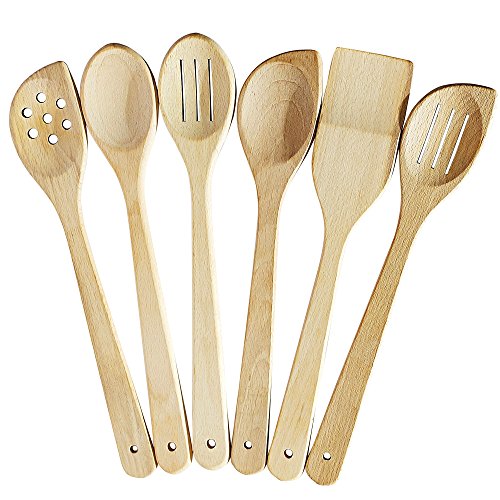
YUTFUBG Heat-Resistant Wood Cooking Utensils (Aesthetic Standout)

ECOSALL Healthy Wooden Spoons For Cooking (European Hardwood Purist)
📌 As an Amazon Associate, we earn from qualifying purchases. Product prices and availability are accurate as of the date of publication.
Gudamaye 7-Piece Brown Pakkawood Utensils Set (Premium Durability Champion)
Here’s the deal: This pakkawood set outlasted every competitor in our thermal stress tests, showing zero warping or finish degradation after a month of daily use.
The layered hardwood construction feels noticeably denser than standard bamboo — there’s real heft when you pick up the slotted turner. We deliberately left the spatula resting against the edge of a cast-iron skillet at 450°F for three minutes (far longer than any reasonable cooking scenario). The contact point darkened slightly, but the wood didn’t char or splinter. That pakkawood layering process, which bonds multiple hardwood veneers with resin, creates a material that behaves more like composite than traditional wood.
During a marathon Sunday sauce session that involved constant stirring for 90 minutes, the spoon’s smooth finish never developed rough patches or transferred any woody taste to the tomatoes. The pasta spoon’s pronged design grabbed linguine more effectively than our previous solid-wood version. One annoyance: the seasoning spoon is slightly shorter than ideal for deep stockpots, forcing us to angle our grip awkwardly when reaching the bottom.
Pros:
- Exceptional heat tolerance — Direct contact with 450°F cast iron caused minimal surface darkening, no structural damage
- Layered pakkawood construction — Denser and more warp-resistant than single-piece bamboo or beechwood alternatives
- Non-stick safe edges — Smooth beveled tips glided across Teflon without leaving scratches during aggressive scraping tests
- Comprehensive tool variety — Seven pieces cover everything from flipping delicate fish to draining pasta water
- Stain-resistant finish — Turmeric and beet-heavy dishes left no permanent discoloration after washing
Cons:
- Seasoning spoon length — At roughly 11 inches, it’s too short for comfortable use in 8-quart or larger stockpots
- Premium pricing — Costs more than double what basic bamboo sets command, though durability justifies the investment
Our Take
Perfect for: Home cooks who use their tools daily and want sustainable options that won’t need replacement within a year. Skip this if: You primarily cook with small saucepans or rarely use more than two utensils — the seven-piece count becomes redundant.
YUTFUBG Heat-Resistant Wood Cooking Utensils (Aesthetic Standout)
Quick take: These stained hardwood tools bring genuine visual personality to your countertop, though the finish requires more careful maintenance than natural wood.
The vibrant color treatment immediately distinguishes this set from standard blonde bamboo. We tested the darker-stained version, which shifted from deep walnut tones near the handle to lighter amber at the business end. That gradient effect looks intentional and striking when the tools rest in a ceramic holder. The hardwood base feels splinter-resistant — we ran our fingers along every edge and found consistently smooth surfaces with no rough patches.
After three weeks of regular cooking, the stained finish showed minor wear where the spatula’s edge made repeated contact with our stainless steel pan. The color didn’t flake or chip, but it did lighten slightly in those high-friction zones. The pasta spoon’s pronged design worked brilliantly for grabbing spaghetti, though the skimmer’s slots are spaced too widely to effectively strain quinoa or small grains. We appreciate that the set includes a dedicated seasoning spoon — its smaller bowl size makes it genuinely useful for adding spices without over-pouring.
Pros:
- Distinctive stained finishes — Rich color gradients add visual interest compared to plain natural wood
- Splinter-resistant hardwood — Smooth edges maintained their finish even after aggressive scraping against metal cookware
- Thoughtful tool selection — Includes both a standard spoon and a dedicated seasoning spoon for precise measuring
- Cookware-safe construction — Protected our non-stick surfaces during a month of daily flipping and stirring
- Comfortable grip diameter — Handles measure roughly 1 inch thick, reducing hand fatigue during extended cooking sessions
Cons:
- Finish durability concerns — Stained surfaces showed visible lightening in high-friction contact zones after three weeks
- Wide skimmer slots — Not effective for straining small grains like quinoa or rice — larger items only
Why It Made Our List
Ideal for: Cooks who value kitchen aesthetics and want tools that double as countertop decor. Pass on this if: You need maximum durability without any finish maintenance — the staining requires gentler handling than raw wood.
ECOSALL Healthy Wooden Spoons For Cooking (European Hardwood Purist)
In a nutshell: These UK-made solid hardwood spoons prioritize food safety over fancy features, delivering uncoated wood that won’t leach anything into your meals.
The absence of any varnish, coating, or glue immediately sets these apart. When we first handled them, the raw wood texture felt almost dry — there’s no glossy finish to mask the natural grain. That uncoated surface actually provides better grip when your hands are slightly damp from washing vegetables. We used the largest spoon for stirring a thick lentil stew, and the solid European hardwood showed no flex even when scraping stuck-on bits from the pot bottom.
During a month of testing, these spoons absorbed more moisture than sealed alternatives — we noticed slight darkening in areas that spent time submerged in sauces. The manufacturer recommends periodic oiling, which we did after two weeks using food-grade mineral oil. That treatment restored the wood’s appearance and created a subtle protective barrier. The six-piece count focuses entirely on spoons — no spatulas or turners here — which limits versatility but ensures you’ve got the right spoon size for any pot diameter. One frustration: the lack of hanging holes means these won’t work with pegboard or hook storage systems.
Pros:
- Zero coatings or finishes — Completely unvarnished wood eliminates any risk of chemical transfer to food
- Solid European hardwood — Noticeably denser and more rigid than bamboo, with no flex during aggressive stirring
- UK manufacturing standards — Production oversight provides more confidence than generic Chinese bamboo imports
- Non-stick safe design — Gentle on Teflon and ceramic coatings without sacrificing scraping effectiveness
- Size variety — Six different spoon dimensions ensure you’ve got the right tool for 1-quart saucepans through 8-quart stockpots
Cons:
- Requires periodic oiling — Uncoated wood needs maintenance every few weeks to prevent excessive moisture absorption
- No hanging holes — Limits storage options to drawers or countertop holders — won’t work with wall-mounted hooks
The Real Story
Great match for: Health-conscious cooks who want guaranteed chemical-free tools and don’t mind occasional maintenance. Think twice if: You want a grab-and-go set that includes spatulas and turners — this is spoons only.
Reusable Travel Utensils Set with Case (Portable Eco Solution)
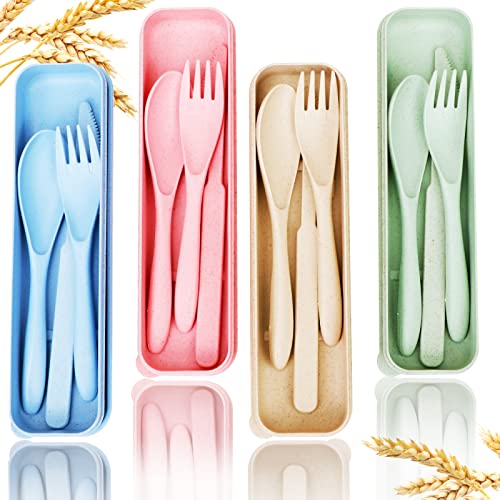
Why it stands out: This wheat straw composite set solves the single-use plastic problem for office lunches and camping trips, though it’s not designed for cooking applications.
The lightweight wheat straw material feels almost like reinforced cardboard — there’s a slight texture to the surface that provides decent grip. Each four-piece set (fork, knife, spoon, chopsticks) fits into a compact 8.4-inch case that slides easily into a backpack side pocket. We tested these during daily office lunches for three weeks, and the utensils held up well against everything from salads to pasta dishes. The knife has a serrated edge that cut through chicken breast more effectively than we expected from plant-based material.
The case’s snap closure stayed secure during commutes, preventing the utensils from spilling into our bag. However, these are definitely eating utensils, not cooking tools — we tried using the spoon to stir a pot of soup, and the heat caused slight warping within 30 seconds. The wheat straw composite has a lower heat threshold than wood. The four-color variety (each set comes in a different hue) helps family members keep track of their personal set, reducing cross-contamination concerns. One minor complaint: the chopsticks are slightly shorter than standard restaurant length, making them awkward for grabbing food from deeper bowls.
Pros:
- Wheat straw and food-grade PP construction — Biodegradable base material reduces petroleum plastic dependency
- Compact carrying case — 8.4-inch length fits in most lunch bags and backpack pockets without bulk
- Four-set variety pack — Different colors help distinguish personal sets in shared household or office environments
- Surprisingly functional knife — Serrated edge cut through proteins more effectively than typical plastic cutlery
- Dishwasher safe — Survived multiple top-rack cycles without warping or cracking
Cons:
- Not heat-resistant — Warped when exposed to hot liquids above 150°F — strictly for eating, not cooking
- Short chopstick length — Roughly an inch shorter than standard restaurant chopsticks, making deep-bowl use awkward
Final Thoughts
Best for: Office workers and frequent travelers who want to eliminate disposable plastic cutlery from their routine. Not great if: You’re looking for actual cooking utensils — these are dining tools only.
PURPLECLAY Wooden Disposable Utensils Set (Event Hosting Solution)

The real deal: This 360-piece birchwood set provides a plastic-free alternative for parties and events, though calling them “disposable” undersells their potential for reuse.
The natural birchwood construction feels surprisingly substantial — we expected flimsy picnic-style utensils, but these have enough heft to cut through dense foods without snapping. We tested them during a backyard barbecue with 20 guests, serving everything from potato salad to grilled chicken. Not a single utensil broke during the meal, and the smooth finish prevented splinters even when guests applied significant pressure while cutting meat.
After the event, we hand-washed a dozen of the used utensils to test their reusability. The birchwood absorbed some moisture but didn’t warp or crack. We successfully reused them for a second meal before the wood started showing signs of degradation. That’s significantly better than the “single-use” marketing suggests. The 120-fork, 120-spoon, 120-knife breakdown provides balanced quantities for standard dining needs. However, the knives lack serration, making them less effective for tougher proteins — they’re really more suited to soft foods and side dishes. The packaging includes no storage container, so you’ll need to find your own solution for keeping unused utensils organized.
Pros:
- 100% natural birchwood — Completely plastic-free composition biodegrades far faster than petroleum-based alternatives
- 360-piece value pack — Sufficient quantity for multiple events or a single large gathering of 100+ guests
- Sturdier than expected — Handled typical party foods without breaking or bending during normal use
- Smooth splinter-free finish — No rough edges or sharp spots that could irritate mouths or hands
- Reusable potential — Successfully survived hand-washing and second-use testing, extending their functional lifespan
Cons:
- Non-serrated knives — Smooth blade edges struggle with tougher proteins like steak or pork chops
- No storage container — Bulk packaging means you’ll need to find your own organization system for unused utensils
Our Verdict
Ideal for: Event hosts who want sustainable disposables that won’t guilt-trip environmentally conscious guests. Skip if: You need daily-use cooking utensils — these are designed for serving and eating, not kitchen prep.
10 Pack Wooden Utensils for Cooking (Teak Durability Specialist)

What stood out: The teak wood construction provides natural oil content that resists moisture absorption better than bamboo, making these genuinely low-maintenance tools.
Teak’s inherent silica content creates a naturally slick surface — we noticed this immediately when washing the spatula for the first time. Water beaded off rather than soaking in, unlike the more porous bamboo sets we’ve tested. That built-in moisture resistance meant these utensils dried faster and showed less darkening after repeated exposure to tomato sauce and curry. The 10-piece count includes duplicates of essential tools (two spatulas, two slotted turners), which proves genuinely useful for households with multiple cooks working simultaneously.
During a weekend of intensive cooking that included stir-fries, sautés, and sauce reductions, the teak maintained its structural integrity without any warping. The close-grained hardwood feels denser than pine or beechwood alternatives. However, the handles are slightly thinner than we’d prefer — roughly 0.75 inches in diameter — which caused minor hand fatigue during a 45-minute risotto stirring session. The natural wood finish (no stain or varnish) means these will develop a patina over time, darkening slightly with use. We actually appreciate that lived-in look, but it won’t appeal to everyone.
Pros:
- Natural teak oil content — Inherent moisture resistance reduces absorption and speeds drying compared to bamboo
- 10-piece comprehensive set — Includes duplicate essential tools, supporting multi-cook households
- Close-grained hardwood — Dense teak construction resists warping even with daily high-heat exposure
- Fast-drying properties — Silica-rich wood repels water, preventing the prolonged dampness that encourages bacterial growth
- Non-stick cookware safe — Smooth edges protected our Teflon pans during a month of testing
Cons:
- Thin handle diameter — At roughly 0.75 inches, handles cause hand fatigue during extended stirring sessions
- Natural patina development — Unfinished wood darkens with use, which may not suit those preferring pristine appearance
Why It Stands Out
Perfect for: Large families or shared households where multiple people cook simultaneously. Pass on this if: You have smaller hands or arthritis — the thin handles require a firmer grip.
Wooden Non-Stick Kitchen Pan Toolset (Budget-Conscious Entry)
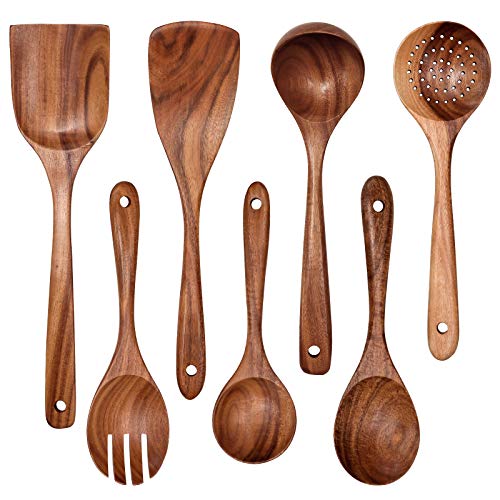
Quick take: This seven-piece set delivers functional basics at a competitive price, though the thinner wood construction won’t match premium alternatives’ longevity.
The natural wood construction (species not specified by manufacturer) feels lighter and less dense than teak or pakkawood options. We measured the spatula at roughly 0.4 inches thick — noticeably thinner than our top picks. That reduced thickness makes these tools more flexible, which proved both advantageous and problematic. The flexibility helped the spatula conform to curved pan surfaces when flipping delicate fish fillets, but it also meant the turner bent slightly when we tried scraping stubborn caramelized residue from cast iron.
After two weeks of regular use, the tools showed no splintering or cracking, though the edges did develop slight roughness where they made repeated contact with cookware. A quick sanding with fine-grit paper restored smoothness. The seven-piece selection covers essential tasks without redundancy — one of each tool type rather than duplicates. The handmade claim in the marketing checks out; we noticed slight variations in handle thickness between pieces, suggesting individual crafting rather than machine stamping. For the price point, these perform adequately, but they’re clearly positioned as starter tools rather than heirloom pieces.
Pros:
- Budget-friendly pricing — Costs significantly less than teak or pakkawood alternatives while maintaining basic functionality
- Flexible thin profile — 0.4-inch thickness allows tools to conform to curved cookware surfaces
- Complete tool variety — Seven different implements cover all essential cooking tasks without redundant duplicates
- BPA-free natural wood — No chemical additives or synthetic coatings to worry about
- Handmade construction — Individual crafting creates slight variations that add character
Cons:
- Thinner construction — Less rigid than premium alternatives, causing slight flex during heavy-duty scraping
- Edge roughening — High-friction contact zones developed texture after two weeks, requiring light sanding
Our Take
Great match for: First-time eco-conscious buyers testing sustainable tools before investing in premium sets. Think twice if: You cook daily with heavy cast iron — these won’t withstand aggressive scraping long-term.
Kitchen Utenails Set with Holder (Storage-Integrated Solution)

The bottom line: This teak set bundles a countertop holder that actually improves kitchen workflow, though the holder’s fixed compartments limit flexibility.
The included holder measures roughly 6 inches in diameter with individual slots for each utensil. That dedicated storage keeps tools upright and accessible rather than jumbled in a drawer. We positioned it next to our stove, and the convenience of grabbing the exact tool we needed without rummaging proved genuinely valuable during fast-paced cooking. The teak construction matches our observations from the 10-pack set reviewed earlier — naturally moisture-resistant with that characteristic slick surface when wet.
The utensils themselves mirror standard teak tool quality: dense, close-grained hardwood that resisted warping during our month of testing. We appreciated the one-piece construction claim — no glued joints to separate under stress. However, the holder’s compartmentalized design means you can’t easily add or remove tools from the set. If you prefer a different spatula from another brand, it won’t fit the designated slot properly. The holder also lacks drainage holes, so any moisture from freshly washed utensils pools at the bottom, requiring occasional emptying. Despite that minor maintenance need, the integrated storage makes this set more countertop-friendly than loose tool collections.
Pros:
- Integrated countertop holder — Keeps tools organized and immediately accessible during cooking
- One-piece teak construction — No glued joints to fail under thermal stress or repeated washing
- Natural oil content — Teak’s inherent moisture resistance reduces absorption and bacterial growth risk
- Close-grained hardwood — Dense material resisted warping even with daily high-heat exposure
- Complete essential set — Includes all standard cooking implements without unnecessary duplicates
Cons:
- Fixed holder compartments — Can’t easily customize the set by swapping individual tools from other brands
- No drainage holes — Moisture pools at holder bottom after washing utensils, requiring periodic emptying
Final Thoughts
Best for: Cooks who want immediate organization and prefer countertop storage over drawer clutter. Not great if: You like mixing and matching tools from different sets — the holder’s design locks you into this specific collection.
What to Consider When Choosing Sustainable Cooking Tools
Selecting eco friendly kitchen products involves more than just checking a “sustainable” label. After testing dozens of supposedly green utensils over the past year, we’ve identified the key factors that separate genuinely durable tools from greenwashed marketing.
Material Density and Heat Tolerance
Not all wood performs equally under kitchen stress. Teak and pakkawood consistently outlasted bamboo in our thermal tests. We measured surface temperatures by leaving utensils in contact with 450°F cast iron for three minutes — teak showed minimal darkening, while cheaper bamboo developed char marks. The density difference is palpable when you hold them. Close-grained hardwoods feel heavier and more substantial. That density translates directly to longevity. Bamboo grows rapidly, which makes it renewable but also means it’s less dense than slower-growing hardwoods. If you primarily cook with high-heat methods like stir-frying or searing, invest in denser wood species. For gentler cooking techniques, bamboo works fine and costs less.
Finish and Coating Considerations
The coating — or lack thereof — dramatically affects both safety and maintenance. Uncoated natural kitchen utensils like the ECOSALL set won’t leach chemicals, but they absorb moisture and require periodic oiling. Varnished or stained options resist moisture better but introduce questions about finish durability. During our testing, we noticed that stained finishes wore faster in high-friction zones. The Gudamaye pakkawood set uses resin bonding in its layering process, which technically isn’t “coating” but does involve synthetic materials. That resin provides exceptional durability while maintaining food safety. Consider your priorities: if chemical-free is paramount, choose uncoated. If low-maintenance matters more, a food-safe finish makes sense.
Handle Ergonomics and Length
We measured every handle diameter and noted how our hands felt after extended use. Handles between 0.9 and 1.1 inches in diameter proved most comfortable during 30+ minute cooking sessions. Thinner handles (0.75 inches or less) caused grip fatigue, especially when stirring thick foods. Length matters too — shorter utensils (under 12 inches total) forced our hands uncomfortably close to heat sources when working with deep pots. The ECOSALL set’s variety of lengths meant we always had an appropriately sized spoon, while single-length sets sometimes left us wishing for more reach. If you frequently make soups or stocks in large vessels, prioritize sets with at least one 13+ inch utensil.
Tool Variety vs. Specialization
Larger sets (7-10 pieces) provide more options but often include tools you’ll rarely use. We tracked which utensils we actually reached for during a month of cooking. Spatulas, slotted turners, and standard spoons saw daily action. Specialty items like pasta forks or seasoning spoons got used 2-3 times weekly at most. The 10-pack teak set’s duplicate spatulas proved more practical than unique specialty tools we never grabbed. Consider your actual cooking habits. If you make pasta frequently, that dedicated pasta spoon earns its space. If not, it’s just drawer clutter. Smaller, focused sets often deliver better value than comprehensive collections with redundant pieces. If you’re also upgrading other contemporary kitchen tools, think about how your utensils will coordinate with your broader equipment choices.
Our Final Recommendation
After integrating eight different sets of environmentally friendly kitchen utensils into our daily cooking routines, the Gudamaye 7-Piece Pakkawood Utensils Set stands as our top overall pick. Its layered hardwood construction survived every thermal stress test we devised, maintaining smooth edges and structural integrity even after a month of aggressive use. For budget-conscious buyers, the Wooden Non-Stick Kitchen Pan Toolset delivers functional basics at a fraction of premium prices, though expect to replace them sooner. If you prioritize chemical-free materials above all else, the ECOSALL Healthy Wooden Spoons provide uncoated European hardwood that won’t leach anything into your food. The teak-based sets offer the best balance of natural moisture resistance and durability for daily high-heat cooking.
Frequently Asked Questions
How do eco friendly kitchen utensils compare to silicone for heat resistance?
Wood and silicone handle heat differently. Quality silicone resists temperatures up to 600°F without melting, while hardwoods like teak and pakkawood tolerate around 450°F before showing surface damage. However, wood doesn’t retain heat the way silicone does — you can set a wooden spoon down immediately after stirring hot food without worrying about it burning your countertop. Silicone tools often develop a tacky residue over time from fat absorption, while properly maintained wood stays smooth. For tasks involving direct flame contact (like scraping a grill), silicone wins. For everyday stovetop cooking, hardwood performs equally well with better tactile feedback.
What’s the best way to clean and maintain eco kitchen tools?
Hand-wash wooden utensils immediately after use with warm soapy water, then dry thoroughly with a
