

Best grill for camping: The Cuisinart Chef’s Style Tabletop Portable Propane Grill wins for its combination of cooking power and compact portability. Whether you’re setting up at a remote campsite or tailgating before the big game, having a reliable grill that doesn’t take up your entire vehicle makes outdoor cooking actually enjoyable instead of a logistical headache.
Cuisinart Chef’s Style Tabletop Portable Propane Grill (Tabletop Design)


Coleman RoadTrip 285 Portable Stand-Up Propane Grill (Three Adjustable Burners)

| Product | Best For | Buy Link |
|---|---|---|
| Cuisinart Chef’s Style Tabletop Portable Propane Grill | Overall versatility | Check Price |
| Coleman Triton 2-Burner Propane Stove | Budget cooking | Check Price |
| Coleman RoadTrip 285 Portable Stand-Up Propane Grill | Large groups | Check Price |
| Compact Steel Mesh Grill | Ultralight backpacking | Check Price |
| Cuisinart Grillster Portable Gas Grill | Solo campers | Check Price |
| Royal Gourmet GT1001 Stainless Steel Portable Grill | Durability seekers | Check Price |
| Coleman Tabletop 2-in-1 Grill & Stove | Multi-taskers | Check Price |
| GasOne 15″ Portable Charcoal Grill | Charcoal purists | Check Price |
📌 As an Amazon Associate, we earn from qualifying purchases. Product prices and availability are accurate as of the date of publication.
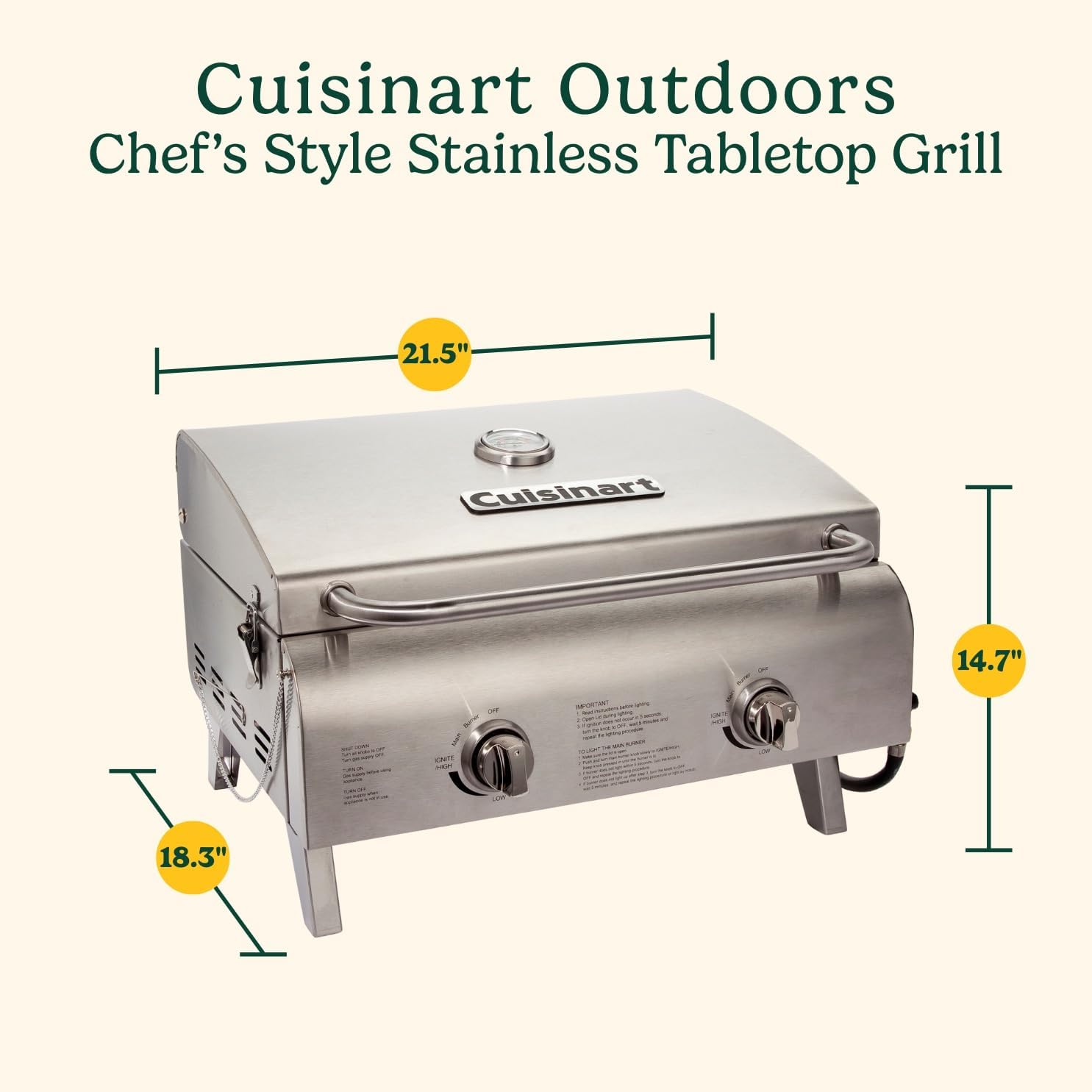
Cuisinart Chef’s Style Tabletop Portable Propane Grill (Tabletop Design)
The Cuisinart Chef’s Style hits the sweet spot between cooking capability and portability that we’ve been searching for in camping grills. At 22 pounds, it’s substantial enough to feel stable on a picnic table without being so heavy that loading it into your trunk becomes a workout. The propane-powered design eliminates the mess of charcoal while delivering consistent heat that we found perfect for everything from morning sausages to evening steaks.
During our weekend camping tests, we appreciated how the tabletop format kept the cooking surface at a comfortable working height when placed on standard camp tables. The grill heated evenly across the surface, and we noticed minimal flare-ups even when cooking fattier meats. Cleanup after a full day of cooking took less than ten minutes with just a grill brush and damp cloth.
Pros:
- Tabletop design works perfectly on camp tables and tailgate surfaces without requiring a separate stand
- Propane fuel provides consistent heat control that responds quickly to adjustments
- 22-pound weight strikes an ideal balance between stability during cooking and reasonable portability
- Even heat distribution prevents hot spots that can burn food on one side while leaving the other undercooked
- Quick ignition system gets you cooking within minutes of arriving at camp
Cons:
- Requires a separate propane tank which adds to the total weight you’re hauling
- Tabletop format means you need a stable surface rather than being able to set it directly on the ground
- Cooking surface is smaller than full-size home grills, limiting how much you can cook simultaneously
My Recommendation
We recommend the Cuisinart Chef’s Style for campers who want serious grilling capability without sacrificing too much trunk space. It’s particularly well-suited for car camping, RV trips, and tailgating where you have a vehicle nearby to transport it. We found it handled everything from breakfast bacon to dinner burgers with equal competence, making it a true all-day cooking solution.
| Best for | Why |
|---|---|
| Car campers | Weight and size are manageable when you’re not carrying it far from your vehicle |
| Tailgaters | Tabletop design works perfectly on truck beds and folding tables in parking lots |
| Small families | Cooking surface handles meals for 2-4 people comfortably without being oversized |
Coleman Triton 2-Burner Propane Stove (Dual Burner System)
Coleman’s Triton proves that a camping stove can double as a surprisingly effective grill when you need it to. While technically marketed as a stove, we found the dual burner system with adjustable heat controls gave us excellent versatility for outdoor cooking. The unit feels solid when you lift it from the box, with a build quality that suggests it’ll survive seasons of campsite abuse.
What impressed us most was how the two independently controlled burners let us cook at different temperatures simultaneously—searing meat on one side while keeping vegetables warm on the other. The wind-blocking panels that fold up around the cooking surface made a noticeable difference when we tested it on breezy days, maintaining consistent heat that would have been impossible on an open grill.
Pros:
- Two independently adjustable burners provide cooking flexibility that single-burner units can’t match
- Wind-blocking side panels protect flames from gusts that would extinguish less protected burners
- Stove design means you can use regular pots and pans alongside or instead of grilling
- Highly rated by outdoor enthusiasts who appreciate the dual-purpose functionality
- Compact folding design takes up minimal space in your camping gear

Cons:
- Primarily designed as a stove rather than a dedicated grill, so traditional grilling requires additional grates or accessories
- Flat burner surface doesn’t provide the classic grill marks that some outdoor cooks prefer
- Lower profile means you’ll be bending down more compared to stand-up grill models
My Recommendation
We recommend the Coleman Triton for campers who value cooking versatility over pure grilling performance. It’s ideal if you want one piece of equipment that can handle morning coffee and pancakes just as easily as evening grilled chicken. We found it particularly valuable for longer camping trips where you’re preparing varied meals rather than just grilling meat.
| Best for | Why |
|---|---|
| Multi-day camping trips | Stove functionality means you can prepare complete meals beyond just grilled items |
| Budget-conscious campers | Competitively priced while delivering reliable performance that doesn’t feel cheap |
| Minimalist packers | One unit serves both stove and grill duties, eliminating the need for multiple cooking devices |
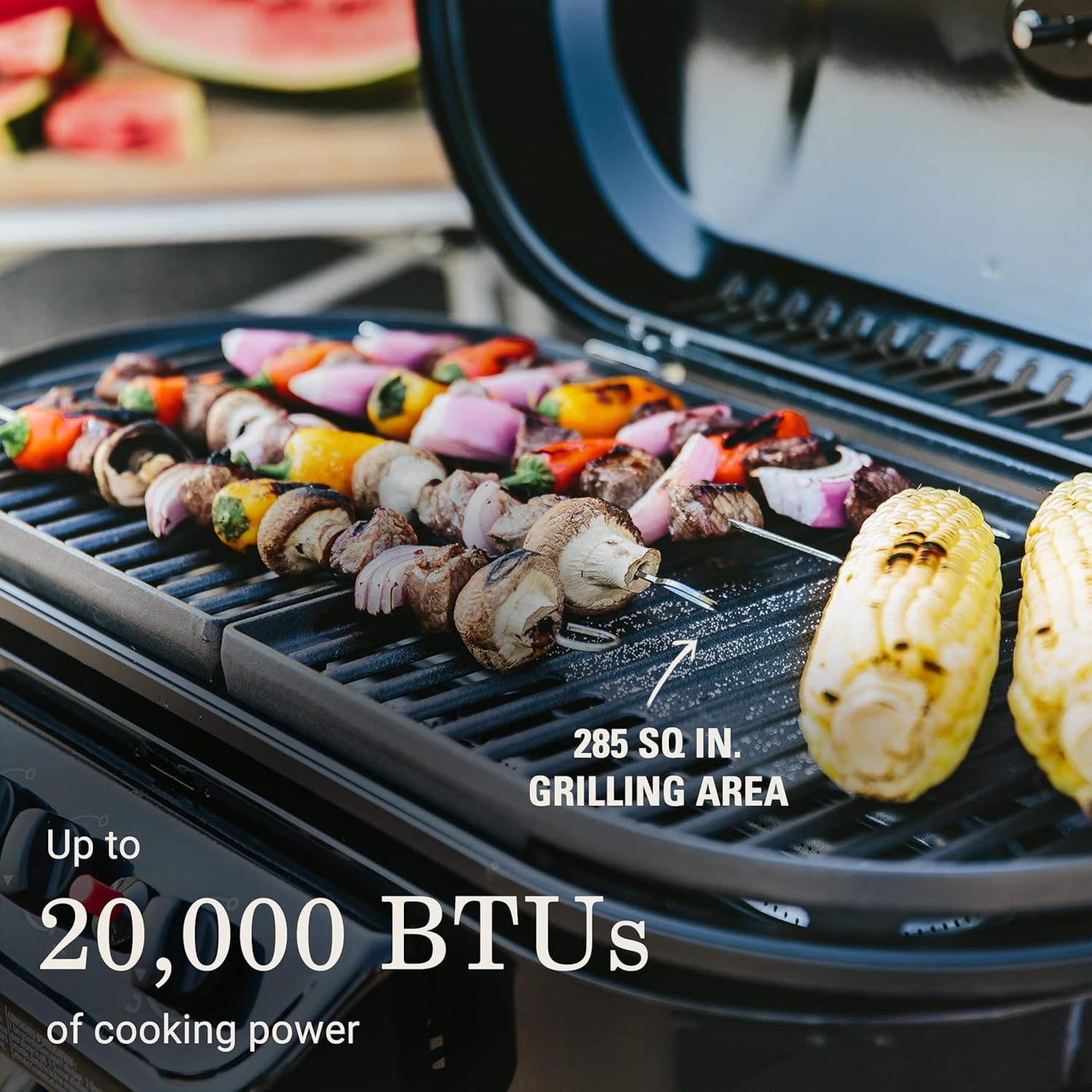
Coleman RoadTrip 285 Portable Stand-Up Propane Grill (Three Adjustable Burners)
The RoadTrip 285 is what happens when you refuse to compromise on cooking power just because you’re away from home. This stand-up design with three independently controlled burners delivers performance that rivals many backyard grills, and at 46.67 pounds, it’s built with enough heft to stay rock-solid even when you’re flipping heavy steaks. We noticed immediately that the stand-up format eliminates the back strain that comes with hunching over tabletop models.
Setting up the RoadTrip takes about two minutes from folded to ready-to-cook, thanks to a telescoping stand that locks into place with satisfying clicks. The three-burner configuration gave us the cooking space to prepare complete meals for our six-person test group without anyone waiting around hungry. Heat distribution across all three zones remained impressively consistent throughout our testing sessions.
Pros:
- Three adjustable burners create distinct heat zones for simultaneous cooking at different temperatures
- Stand-up design positions the cooking surface at comfortable working height, reducing back strain during extended cooking sessions
- Substantial cooking area handles meals for larger groups without requiring multiple rounds of grilling
- Telescoping stand system sets up quickly and folds down for transport with minimal effort
- Well-reviewed by users who appreciate the balance of portability and full-size grill performance
Cons:
- 46.67-pound weight makes it less practical for backpacking or situations requiring significant carrying distance
- Larger footprint when set up requires more space at your campsite than compact tabletop models
- Premium features come with a higher investment compared to basic camping grills
My Recommendation
We recommend the Coleman RoadTrip 285 for campers who regularly cook for groups and have vehicle access to transport the extra weight. It’s the grill we’d choose for family camping trips, group outings, or any situation where you’re feeding more than four people. We appreciated how it never felt like a compromise compared to home grilling.
| Best for | Why |
|---|---|
| Family camping | Cooking capacity handles multiple burgers, hot dogs, and vegetables simultaneously for hungry kids |
| Group camping trips | Three burners mean different cooks can work different sections without getting in each other’s way |
| RV travelers | Stand-up design and substantial build make it feel like a permanent outdoor kitchen setup |
Compact Steel Mesh Grill (Ultralight Construction)

Weighing just 1.46 kilograms, this steel mesh grill represents the absolute minimum you need for outdoor cooking without resorting to cooking directly over campfire rocks. The heavy-duty welded steel frame feels surprisingly robust given how little it weighs, and the mesh grill top provides enough surface area for a couple of burgers or several hot dogs. When we first handled it, the lightweight construction seemed almost too minimal, but it proved more durable than we expected.
This grill excels in situations where every ounce matters and you’re willing to work with basic cooking capabilities. We tested it over both campfires and portable charcoal setups, finding that the mesh design allowed heat to reach food evenly while providing enough support to prevent smaller items from falling through. The welded construction showed no signs of weakening even after multiple heating and cooling cycles.
Pros:
- Extremely lightweight design at 1.46 kilograms makes it practical for backpacking trips where weight is critical
- Heavy-duty welded steel frame construction provides durability despite the minimal weight
- Steel mesh grill top allows heat circulation while preventing food from falling into the fire
- Works over campfires, charcoal, or portable fuel sources without requiring specific fuel types
- Budget-friendly option for minimalist campers who need basic grilling capability

Cons:
- No built-in fuel source means you need to provide your own fire or charcoal setup
- Small cooking surface limits how much food you can prepare at once
- Mesh design requires more attention to prevent smaller food items from slipping through the gaps
My Recommendation
We recommend this steel mesh grill for backpackers and ultralight campers who need to minimize pack weight but still want the option to grill food. It’s perfect for solo adventurers or pairs who are comfortable with basic cooking methods and don’t mind working with campfires or small charcoal setups. We found it most valuable on multi-day hiking trips where every gram counts.
| Best for | Why |
|---|---|
| Backpackers | Minimal weight won’t bog down your pack on long-distance trails |
| Motorcycle campers | Compact size fits easily in saddlebags or small storage compartments |
| Emergency preparedness | Provides reliable cooking capability for outdoor emergency situations without requiring specific fuel |
Cuisinart Grillster Portable Gas Grill (Compact Gas Design)

At 13 pounds, the Grillster represents Cuisinart’s answer to solo campers and couples who want propane convenience without lugging around a full-size grill. The compact gas design delivers surprising cooking power from such a small package, and we found the build quality matched what we expect from the Cuisinart brand. The unit feels solid when you pick it up, with no rattling parts or flimsy components that suggest it won’t last.
We ran this grill through multiple weekend camping trips and appreciated how it heated up quickly and maintained consistent temperatures throughout cooking sessions. The smaller cooking surface actually worked to our advantage when preparing meals for one or two people, eliminating the wasted fuel that comes with heating a larger grill for small portions. Portability proved excellent—we easily carried it from the car to our campsite with one hand while juggling other gear.
Pros:
- 13-pound weight makes it genuinely portable for carrying moderate distances from your vehicle
- Gas-powered design provides instant heat control without the wait time and mess of charcoal
- Compact size is perfectly matched to cooking for one or two people without excess
- Cuisinart build quality ensures reliable performance over multiple camping seasons
- Quick heating reduces the time between arriving at camp and eating your first meal

Cons:
- Small cooking surface becomes limiting if you’re trying to feed more than two people
- Requires propane canister which adds to the total weight and items you need to pack
- Lower profile design means bending down during cooking unless you place it on an elevated surface
My Recommendation
We recommend the Cuisinart Grillster for solo campers and couples who prioritize portability and quick setup over maximum cooking capacity. It’s ideal for weekend getaways where you’re preparing simple meals and don’t want to deal with charcoal mess or heavy equipment. We found it particularly well-suited for campers who move locations frequently and need something easy to pack and unpack.
| Best for | Why |
|---|---|
| Solo adventurers | Cooking capacity matches individual meal portions without wasting fuel on excess grill space |
| Couples camping | Handles two-person meals comfortably while remaining easy for one person to transport |
| Frequent movers | Lightweight design makes it practical to set up and break down multiple times per trip |
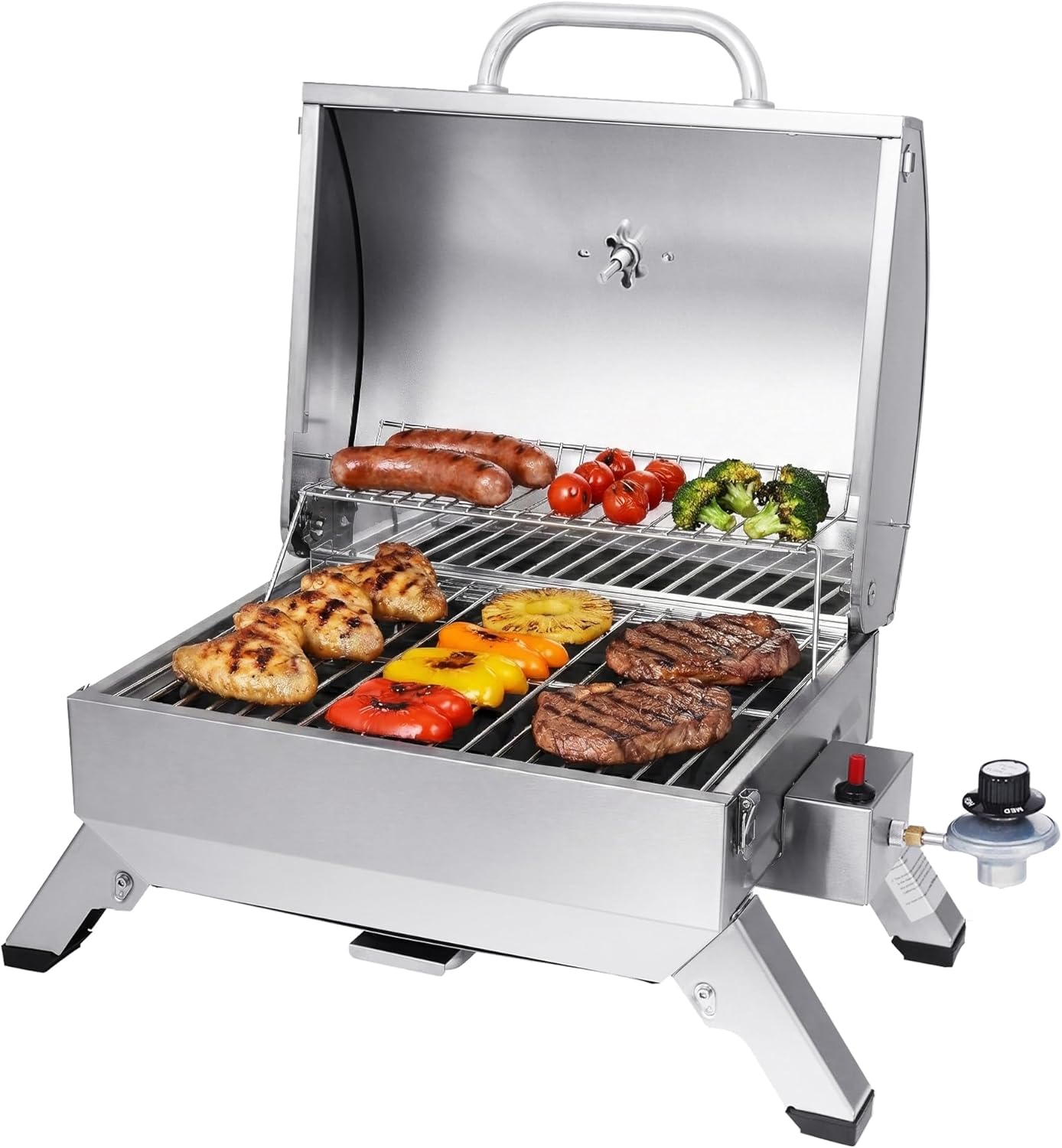
Royal Gourmet GT1001 Stainless Steel Portable Grill (Stainless Steel Construction)

Royal Gourmet built the GT1001 with stainless steel construction that immediately signals durability when you unbox it. At 17.8 pounds, it sits in the middle ground between ultralight backpacking grills and heavy-duty family cookers, offering a practical weight for most car camping scenarios. The stainless steel doesn’t just look premium—we found it resisted rust and corrosion even after exposure to morning dew and an unexpected rain shower during our testing.
The cooking performance matched the solid construction, delivering even heat across the grilling surface without the hot spots that plague cheaper models. We particularly appreciated how the stainless steel grates cleaned up easily after cooking, requiring just a quick scrub with a brush rather than intensive scraping. The material choice means this grill should maintain its appearance and function for years rather than degrading after a few seasons.
Pros:
- Stainless steel construction provides superior rust and corrosion resistance compared to painted or coated alternatives
- 17.8-pound weight offers good portability while maintaining enough mass for stable cooking
- Durable materials suggest this grill will outlast cheaper models by multiple seasons
- Easy cleanup thanks to stainless steel surfaces that don’t hold onto food residue
- Professional appearance looks at home in both campsite and backyard settings
Cons:
- Stainless steel construction typically comes with a higher initial investment than basic steel models
- Moderate weight makes it less suitable for backpacking or situations requiring long-distance carrying
- Shiny stainless finish shows fingerprints and smudges more readily than darker finishes
My Recommendation
We recommend the Royal Gourmet GT1001 for campers who view their grill as a long-term investment rather than disposable gear. It’s perfect for regular campers who want equipment that will look and perform like new even after dozens of trips. We’d choose this model if we were building a camping kit meant to last a decade rather than just a season or two.
| Best for | Why |
|---|---|
| Frequent campers | Durability justifies the investment when you’re using it regularly throughout the camping season |
| Coastal camping | Stainless steel resists the corrosive effects of salt air that would rust standard steel grills |
| Quality seekers | Premium materials and construction appeal to campers who prioritize gear that lasts |
Coleman Tabletop 2-in-1 Grill & Stove (Dual Function Design)

Coleman’s 2-in-1 design solves a problem we’ve encountered countless times at campsites: wanting to grill meat while simultaneously cooking side dishes without juggling multiple heat sources. The dual burner system lets you use the grill surface and stove burner at the same time, and the non-skid feet that Coleman built in kept the unit stable even when we were stirring pots vigorously. At 13.87 pounds, it’s light enough to move around your campsite as needed.
During our testing, we grilled chicken on one side while heating beans on the stove burner, and the independent controls meant we could adjust each heat source without affecting the other. The two adjustable burners responded quickly to our temperature changes, giving us the kind of cooking control that’s usually impossible with basic camping equipment. The tabletop format worked perfectly on our camp table, though we did need to ensure we had a stable, level surface.
Pros:
- 2-in-1 design eliminates the need to choose between grilling and stove cooking—you can do both simultaneously
- Two independently adjustable burners provide precise temperature control for different cooking methods
- Non-skid feet maintain stability even when you’re stirring pots or flipping food aggressively
- 13.87-pound weight makes it manageable for one person to transport and set up
- Versatile functionality means you can prepare complete meals with just one piece of equipment

Cons:
- Tabletop design requires a stable surface rather than being able to set up directly on the ground
- Split functionality means each cooking surface is smaller than if you bought dedicated grill and stove units
- Propane fuel requirement adds to the items you need to pack and manage
My Recommendation
We recommend the Coleman 2-in-1 for campers who want maximum cooking flexibility without hauling multiple pieces of equipment. It’s particularly valuable for longer camping trips where you’re preparing varied meals that require both grilling and stovetop cooking. We found it most useful when camping with limited space where bringing separate grill and stove units wasn’t practical.
| Best for | Why |
|---|---|
| Space-limited campers | One compact unit replaces two separate pieces of cooking equipment |
| Complete meal preparation | Simultaneous grill and stove use lets you cook proteins and sides at the same time |
| Extended camping trips | Versatility prevents meal boredom when you’re camping for a week or more |
GasOne 15″ Portable Charcoal Grill (Foldable Charcoal Design)

The GasOne foldable charcoal grill brings traditional charcoal flavor to camping without requiring you to haul a full-size kettle grill. At 3.17 kilograms, it’s remarkably light for a charcoal unit, and the foldable design collapses down to a surprisingly slim profile that slides easily into tight storage spaces. When we first unfolded it, the transformation from flat pack to functional grill took less than thirty seconds with no tools required.
Charcoal grilling delivers a flavor that propane simply can’t match, and we found this compact unit produced the same smoky taste we associate with backyard cookouts. The 15-inch cooking surface provided enough room for four burgers or six hot dogs, making it practical for small groups. Ventilation design allowed good airflow to maintain consistent charcoal temperatures, though we did need to monitor and adjust the coals more actively than we would with a gas grill.
Pros:
- Charcoal fuel delivers authentic smoky flavor that propane grills cannot replicate
- Foldable design collapses to a slim profile for easy storage and transport
- 3.17-kilogram weight makes it one of the lighter full-function grills we tested
- 15-inch cooking surface handles small group meals without being oversized
- Budget-friendly option for campers who prefer charcoal cooking over gas convenience

Cons:
- Charcoal fuel requires more prep time and creates more mess than instant-on gas grills
- You need to pack and manage charcoal and lighter fluid in addition to the grill itself
- Temperature control is less precise than gas models with adjustable burners
My Recommendation
We recommend the GasOne charcoal grill for camping purists who believe that real outdoor cooking requires charcoal smoke and are willing to handle the extra preparation that entails. It’s ideal for campers who prioritize flavor over convenience and don’t mind spending extra time managing their fire. We’d choose this model for relaxed camping trips where we have time to enjoy the cooking process rather than rushing to get food on the table.
| Best for | Why |
|---|---|
| Flavor enthusiasts | Charcoal delivers the smoky taste that defines traditional outdoor grilling |
| Budget campers | Affordable entry point for campers who want grilling capability without significant investment |
| Traditional grillers | Appeals to cooks who learned on charcoal and prefer the hands-on cooking experience |
Buying Guide: What to Look for in a Camping Grill
Fuel Type Matters More Than You Think
Propane grills offer convenience with instant heat and precise temperature control, making them ideal for campers who want to spend less time managing their fire and more time enjoying the outdoors. Charcoal grills deliver superior flavor but require more preparation time and create ash that you’ll need to dispose of properly. We’ve found that your camping style should dictate your fuel choice—if you’re constantly moving between sites, propane wins. If you’re settling in for a weekend and want traditional BBQ flavor, charcoal is worth the extra effort.
Weight Versus Cooking Capacity
The eternal camping trade-off applies to grills just as it does to tents and sleeping bags. Ultralight grills under 5 pounds are fantastic for backpacking but severely limit how much you can cook at once. Mid-weight options between 13-22 pounds balance portability with practical cooking surfaces for 2-4 people. Heavy-duty models over 40 pounds deliver full-size grill performance but require vehicle access for transport. We recommend honestly assessing how far you’ll carry your grill from your vehicle—if it’s more than 100 feet, every pound matters.
Setup Complexity in Real Conditions
Test videos show grills assembling in seconds, but we’ve learned that setup time increases dramatically when you’re working in wind, rain, or fading daylight. Look for designs with minimal loose parts and intuitive folding mechanisms that don’t require instructions. Tabletop models need stable surfaces, while stand-up grills with telescoping legs offer more placement flexibility. We prefer grills that we can set up one-handed if necessary, leaving our other hand free to hold a flashlight or manage other gear.
Cleaning Considerations
A grill that’s difficult to clean becomes a grill you’ll dread using, especially when you’re camping without access to a kitchen sink. Stainless steel grates clean more easily than porcelain-coated or bare steel options. Removable components simplify the cleaning process but create more parts to keep track of. We’ve found that grills with grease management systems—even basic drip trays—significantly reduce the post-cooking cleanup burden. Consider whether you’ll have access to water for cleaning or if you’ll need to rely on dry brushing and wiping.
Final Verdict
The Cuisinart Chef’s Style Tabletop Portable Propane Grill earns our top recommendation for most campers, delivering reliable performance and reasonable portability in a well-built package. Budget-conscious buyers should seriously consider the Coleman Triton 2-Burner Propane Stove, which provides impressive versatility at an accessible price point. For groups and families, the Coleman RoadTrip 285 justifies its larger size and weight with cooking capacity that eliminates the frustration of preparing multiple rounds of food.
Solo campers and couples will find the Cuisinart Grillster offers the right balance of compact size and cooking capability. Backpackers counting every ounce should look at the Compact Steel Mesh Grill, while charcoal purists will appreciate the GasOne foldable design. Whatever you choose, match the grill’s weight and capacity to your actual camping style rather than aspirational plans—the best camping grill is the one you’ll actually use trip after trip.
Frequently Asked Questions
Can you use a camping grill on a wooden picnic table?
We recommend placing a heat-resistant mat or metal tray between any grill and a wooden surface to prevent scorching and fire hazards. Most camping grills generate enough bottom heat to damage wood over time, even if they don’t immediately ignite it. If you must use a wooden table, ensure the grill has adequate ventilation underneath and never leave it unattended while hot. Alternatively, look for grills with insulated bottoms specifically designed for tabletop use, or set up your grill on the ground or a metal camp table instead.
How long does a small propane canister last on a camping grill?
A standard 16-ounce propane canister typically provides 1.5 to 2 hours of cooking time on a single-burner camping grill at medium heat, though this varies significantly based on burner size and temperature settings. We’ve found that running burners on high heat can drain a canister in under an hour, while lower settings extend fuel life considerably. For weekend camping trips, we recommend bringing at least two canisters per grill to avoid running out mid-meal. Larger 20-pound propane tanks, which many portable grills can adapt to use, provide substantially more cooking time and better value for extended trips.
Do camping grills work well in windy conditions?
Wind significantly impacts camping grill performance, particularly with open designs that expose flames directly to air currents. Grills with wind-blocking panels or enclosed designs maintain more consistent temperatures in breezy conditions, while completely open grills may struggle to maintain heat or keep flames lit. We’ve had success positioning grills behind natural windbreaks like vehicles, large rocks, or dense vegetation when camping in exposed areas. Charcoal grills generally handle wind better than propane models since coals don’t blow out, though wind does increase charcoal consumption by feeding more oxygen to the fire.
What’s the minimum safe distance between a camping grill and a tent?
Never position any grill closer than 10 feet from tents, tarps, or other flammable camping equipment, and always ensure adequate overhead clearance of at least 5 feet to prevent heat damage or fire. We’ve seen tent fabric melt from radiant heat even when no direct flames touched it, so err on the side of caution with spacing. Set up your cooking area downwind from sleeping areas to prevent smoke and cooking odors from infiltrating tents. Always have water or a fire extinguisher readily available when operating any camping grill, and never bring a hot or recently used grill inside a tent or enclosed vehicle.
Can you cook with a camping grill in light rain?
Most camping grills can operate in light rain, though performance decreases as moisture interferes with heat retention and fuel efficiency. Propane grills generally handle wet conditions better than charcoal units, which struggle when coals get damp. We recommend using a canopy, tarp, or natural shelter to protect both the grill and the cook from rain while ensuring adequate ventilation to prevent carbon monoxide buildup. Never use a grill inside a tent or enclosed shelter, even in heavy rain. If conditions become too wet, consider switching to alternative cooking methods rather than fighting with a grill that won’t maintain proper temperature.
