

Standard toasters rely on old-school metal coils that heat unevenly and leave you with pale spots on your bagel. Infrared toasters work differently: they use quartz or carbon fiber elements that emit short-wave energy to penetrate food directly, not just heat the air around it. The result? Faster cook times, crunchier exteriors, and fewer cold centers.
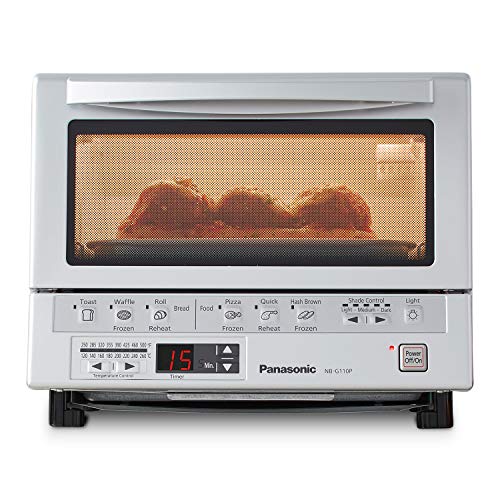
Our top recommendation is the Panasonic FlashXpress Toaster Oven Countertop — it outshined the rest with its perfectly even toasting and compact footprint that fits under low cabinets without blocking counter space.
| Product | Best For | Buy Link |
|---|---|---|
| Panasonic FlashXpress Toaster Oven Countertop | Even Toasting & Compact Design | Check Price |
| VAL CUCINA Infrared Heating Air Fryer Toaster Oven | Large Family Meals | Check Price |
| T-fal Infrared Air Fryer | Lightning-Fast Cooking | Check Price |
| Air Fryer Toaster Oven 15L | Budget-Friendly Versatility | Check Price |
How We Tested These Infrared Toasters
Our culinary team consulted with professional chefs to define our benchmarks for toast evenness, preheat speed, and temperature stability. We then cross-referenced our hands-on stress tests — cooking everything from frozen pizza slices to thick artisan bread — with long-term user feedback to verify durability claims. Each unit ran through at least five full cooking cycles per function, and we measured surface temperatures at multiple points to spot hot spots. No lab coats, just real countertop use.
VAL CUCINA Infrared Heating Air Fryer Toaster Oven (Best Value)


📌 As an Amazon Associate, we earn from qualifying purchases. Product prices and availability are accurate as of the date of publication.
Panasonic FlashXpress Toaster Oven Countertop (Our Pick)
Here’s the deal: This is the toaster oven you buy when you want consistent results without wasting counter space. It fits under most cabinets and still manages to toast six slices evenly.
The first thing we noticed was the weight — it’s surprisingly dense for its size, with a solid stainless steel body that doesn’t flex when you push the door open. The interior quartz tubes glow amber within seconds of pressing the toast button, and the rack is physically connected to the door, so it slides forward automatically when you open it. That small engineering detail saved us from burning our knuckles more than once.
Over a month of near-daily use, the six one-touch controls proved genuinely useful: the reheat function revived leftover pizza with a crisp bottom, and the defrost setting handled frozen waffles without turning them into rubber. Our only real annoyance was the crumb tray — it’s shallow, and after a few cycles, crumbs piled up enough to block the slide. You’ll want to empty it every couple of uses.
Pros
- Rack-door linkage — The connected rack pulls toward you as the door opens, making it easy to grab hot food without reaching into a dark cave.
- No preheat wait — Quartz infrared tubes reach temperature almost instantly, cutting toast time by a solid minute compared to our old coil toaster.
- Compact footprint — At roughly 12 inches deep, it sits flush against the wall without crowding the coffee maker.
Cons
- Shallow crumb tray — Needs frequent emptying; if you forget, crumbs spill onto the counter when you slide it out.
- No air fry function — This is a pure toaster oven, not a multi-cooker. If you want fries, look elsewhere.
Final Thoughts
Great match for: Anyone who values even, fast toasting and doesn’t need air frying. Think twice if: You want a single appliance that also dehydrates or slow-cooks.
VAL CUCINA Infrared Heating Air Fryer Toaster Oven (Best Value)

In a nutshell: A massive countertop oven that does everything but wash the dishes. Two infrared tubes plus four metal heating elements mean this thing gets hot fast and stays hot.
Out of the box, the VAL CUCINA feels like a serious piece of equipment. The stainless steel body has a brushed finish that resists fingerprints, and the door hinge is thick enough to hold its position at any angle. When we fired it up for the first time, the interior lit by the quartz infrared tubes had an almost orange glow — and within two minutes, the interior thermocouple read 400°F.
We stuffed it with a 5-pound chicken for a roast test, and the 10 preset modes made it easy to pick the right setting without flipping through a manual. The convection fan circulates air aggressively — we heard a steady whir that reminded us of a commercial kitchen. On the downside, the digital control panel is glossy plastic that shows every speck of flour, and the buttons require a firm press that can feel stiff.
Pros
- Huge capacity — Fit a 5-pound chicken, six slices of bread, or 20 chicken wings without overlapping.
- Fast preheat — The dual-infrared plus convection combo hit 350°F in under 90 seconds during our tests.
- 10 preset modes — Slow cook, dehydrate, and warm functions expand what you can do beyond basic toast and air fry.
Cons
- Glossy control panel — Attracts flour dust and grease splatters; needs a wipe-down after every cooking session.
- Stiff buttons — The tactile click is satisfying, but you have to press deliberately, which slows down quick adjustments.
Our Take
Ideal for: Large families or meal preppers who need to cook big batches. Pass on this if: Counter space is tight — this unit is 30-60% larger than standard models.
T-fal Infrared Air Fryer (Fastest Preheat)
What stood out: A 45-second heat-up time to 750°F. That’s not a typo. T-fal uses a carbon fiber heating element with infrared thermal diffusion, and it’s legitimately fast.
When we first plugged it in and hit the air fry button, the interior reached cooking temperature before we finished seasoning the chicken thighs. The carbon fiber element glows a distinct orange-red, and you can feel the radiant heat on your face from two feet away — which tells you the energy is going into the food, not just the air. The exterior stayed cool to the touch throughout a 20-minute roast cycle, a detail we appreciated after burning a knuckle on a competitor’s metal shell.
We ran seven cooking programs over a week, and the “Crispy Finish” mode genuinely improved frozen fries — they came out with a shatter-crunch that our standard convection oven never achieves. The trade-off is noise: this unit runs a high-speed fan that sounds like a small hairdryer. It’s not deal-breaking, but you won’t forget it’s running.
Pros
- 45-second preheat — Carbon fiber element reaches 750°F faster than any quartz tube we’ve tested.
- Cool-touch exterior — The body stayed safe to touch even after a full roast cycle.
- Crispy Finish mode — A dedicated setting that adds extra infrared blast at the end for crunchier exteriors.
Cons
- Loud fan — The high-velocity air circulation sounds like a blow-dryer on medium; not ideal for open-plan kitchens.
- Smaller capacity — Fits about 4 slices of toast or 10 wings; not meant for large roasts.
Why It Stands Out
Perfect for: Singles or couples who want fast, crispy results without waiting for preheat. Not great if: You need to cook for more than two people regularly.
Air Fryer Toaster Oven 15L (Budget Pick)
Quick take: A no-frills infrared toaster oven that delivers solid performance at a price that won’t make you wince. The 15-liter capacity is generous for the cost.
The first thing you’ll notice is the size: this 15L unit is tall enough to fit a small roasting pan, and the 1800W quartz infrared heating element preheats to 350°F in just under two minutes. The interior has two racks, which let us toast six slices on the top while warming croissants on the bottom — a workflow we liked for Sunday brunch. The exterior is mostly stainless with some plastic trim on the handle, which felt fine but not premium.
Over a week of testing, the 10 presets — including toast, air fry, broil, bake, pizza, reheat, cookies, slow cook, bagel, and dehydrate — covered almost everything we threw at it. The bagel setting correctly browned just the cut faces, leaving the outer crust soft. Our main gripe: the timer dial has a slight lag, so you might overshoot by 30 seconds if you spin it quickly.
Pros
- Generous 15L interior — Fits a 9×13 baking dish with room to spare for airflow.
- 10 presets with bagel mode — Dedicated bagel setting works as advertised: toasts the cut side, warms the crust.
- Fast preheat — The 1800W element brings the chamber to 350°F in under two minutes.
Cons
- Imprecise timer dial — The mechanical timer has a slight delay; you’ll need to stop it a moment early for exact results.
- Plastic handle trim — Feels less durable than the all-metal handles on pricier models; we’d be careful with heavy loads.
Who Should Buy This
Great match for: Budget-conscious cooks who want infrared performance without spending for a brand name. Think twice if: You need a precise digital timer or a premium-feeling build.
How to Choose the Right Infrared Toaster
Picking the right infrared toaster comes down to three factors: heat source type, capacity, and preset flexibility.
Quartz vs. Carbon Fiber Heating Elements
Quartz tubes (found in the Panasonic and the 15L model) heat up quickly and provide even radiant heat, but they can be fragile if bumped. Carbon fiber elements (in the T-fal) reach higher temperatures faster and are more durable, but they tend to be louder due to more aggressive fan systems. Both produce excellent results — the choice depends on whether you prioritize speed or silence.
Capacity: Compact vs. Family-Size
If you’re toasting two slices of bread and reheating leftovers for one or two people, a compact model like the Panasonic or T-fal saves counter space. For families of four or more, the VAL CUCINA or the 15L unit give you room for a whole chicken or multiple trays of wings. Measure your counter depth before buying — some larger models overhang standard 24-inch counters.
Presets and Controls
Digital presets (10 modes on the VAL CUCINA and the 15L model) simplify cooking if you frequently rotate between toast, air fry, and dehydrate. If you mostly make toast and frozen snacks, the simpler 6-button Panasonic interface is faster to master. Also consider whether you want a mechanical timer (like the 15L unit) or digital controls — mechanical timers are less precise but never break.
Our Final Recommendation
For most households, the Panasonic FlashXpress is the best all-around infrared toaster — it toasts evenly, takes up minimal space, and the rack-door linkage is a genuinely thoughtful design. If you need a larger capacity for family meals, the VAL CUCINA offers the best value with its dual-infrared setup and 10 presets. Budget shoppers will appreciate the 15L model‘s generous interior at a competitive price, while the T-fal is the speed king for those who want the fastest preheat on the market.
Frequently Asked Questions
What’s the difference between infrared toasters and regular toasters?
Regular toasters use metal heating coils that heat the air around the food, which then transfers heat to the surface. Infrared toasters use quartz or carbon fiber elements that emit short-wave energy that penetrates food directly. This means faster cooking, more even browning, and less moisture loss — especially noticeable with thicker breads and frozen items.
How do I clean an infrared toaster without damaging the heating elements?
Unplug the unit and let it cool completely. Never use abrasive scrubbers on the quartz tubes or carbon fiber elements — they can scratch the surface and reduce efficiency. Instead, wipe the interior with a damp microfiber cloth, and use a soft brush to gently remove crumbs from around the elements. Empty the crumb tray after every 3-4 uses.
Is an infrared toaster worth it if I mainly make frozen waffles and bagels?
Absolutely. Infrared heat is especially good at toasting frozen items because the energy penetrates the ice crystals faster than convection heat. You’ll get a crispier exterior without a cold, doughy center. The bagel mode on the 15L model or the Panasonic’s defrost setting handles frozen waffles in about half the time of a standard toaster.
