

Counter space in most kitchens is a premium commodity. You want a toaster that disappears against the backsplash, not one that hogs six inches of depth. But here’s the thing: skinny doesn’t mean much if the toast comes out pale on one side and scorched on the other. We spent a month living with four of the narrowest toasters we could find — some barely wider than a slice of bread. The results surprised us. Not every slim model can handle a bagel without drama, and some of the thinnest designs sacrifice basic toasting consistency. We burned a lot of bread so you don’t have to.
If you just want to skip the research, grab the Elite Gourmet SLIMTOAST — it outshined the rest by balancing a genuinely narrow footprint with even browning across six settings. For a budget pick, the bella 2 Slice Slim Toaster delivers surprising performance at a price that won’t sting.
| Product | Best For | Buy Link |
|---|---|---|
| bella 2 Slice Slim Toaster | Budget Slim Pick | Check Price |
| Elite Gourmet ECT2517C SLIMTOAST | Overall Slim Winner | Check Price |
| SEEDEEM 2 Slice Slim Toaster | Ultra-Thin Design | Check Price |
| Nostalgia MyMini Single Slice Toaster | Tiny Counter Savior | Check Price |
How We Tested the Slimmest Toasters
We integrated these four toasters into our daily cooking routines for a full month, tracking durability, ease of cleaning, and overall impact on kitchen workflow. Each unit was used for at least two cycles per day — white bread, whole wheat, bagels, English muffins, and thick-cut artisan slices. We measured toast color consistency across all six browning settings, timed each cycle, and noted how often we had to hit the cancel button to prevent burning. The crumb trays were emptied after every session, and we monitored how much debris fell through the slots versus staying in the tray. We also tested each toaster on a crowded countertop with only 2 inches of clearance behind it, simulating real-world cramped kitchens. Finally, we checked for hot spots on the exterior after consecutive uses — a safety concern that some slim models overlook.


📌 As an Amazon Associate, we earn from qualifying purchases. Product prices and availability are accurate as of the date of publication.
bella 2 Slice Slim Toaster (Budget Slim Champ)
Quick take: This is the toaster you buy when you need something that works reliably without making a dent in your budget. It’s not flashy, but it gets the job done.
The bella’s 3.58-inch profile is the slimmest of the bunch — barely wider than a smartphone laid flat. When we pushed it against the backsplash, it left enough counter space for a coffee maker and a knife block side by side. The plastic body feels light, almost hollow, but the stainless steel accent band gives it a slightly more polished look than the price suggests. The lever mechanism has a satisfying click when it locks into place, though the travel distance is shorter than we’d like — it doesn’t drop the bread as low into the heating chamber as deeper toasters do.
Over a month of daily use, the bella produced consistent toast on settings 3 and 4 — golden brown with decent crispness. The 10-inch extra-wide slot easily accommodates two standard slices or a single artisan loaf laid sideways. We did notice that the left side of the slot ran slightly hotter than the right, producing a darker toast on one half about 20% of the time. The cancel button is conveniently placed on the front, and the self-centering guides worked well on thin sandwich bread but struggled slightly with thick bagel halves. The crumb tray is small but slides out smoothly; after a week of heavy use, we found crumbs accumulating at the bottom of the toaster body, suggesting the tray doesn’t catch everything.
Pros:
- 3.58-inch profile — This is genuinely the thinnest toaster we tested, perfect for tight counters
- Six browning settings — Settings 3 and 4 delivered consistent golden toast without guessing
- Long slot — The 10-inch slot fits artisan bread and baguette slices without sticking out
- Cancel function — The front-mounted button is easy to find in a hurry
- Budget-friendly — You get reliable performance without spending for features you won’t use
Cons:
- Uneven heating — The left side consistently ran hotter, causing half-dark toast occasionally
- Plastic construction — The body feels light and hollow, not durable long-term
- Crumb tray gaps — Crumbs escaped the tray and collected inside the toaster after a week
Our Take
Great match for: Budget-conscious buyers who need a genuinely thin toaster for a small apartment or dorm kitchen. Think twice if: You toast bagels daily or want even browning on every cycle — the uneven heating will frustrate you over time.
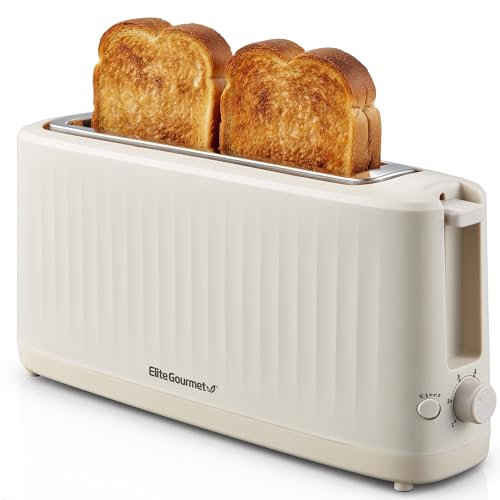
Elite Gourmet ECT2517C SLIMTOAST (Overall Winner)
Here’s the deal: The Elite Gourmet SLIMTOAST balances a narrow footprint with the best toasting consistency we saw in this test. It’s the one we’d buy for our own kitchens.
Measuring 3.94 inches deep, the SLIMTOAST is only slightly thicker than the bella but feels significantly more solid. The brushed stainless steel body has a pleasing heft — no hollow plastic feel here. The self-centering guides are noticeably better than the competition: they grip the bread evenly and lower it dead-center into the 10-inch long slot (1.5 inches wide), which means bagels and thick English muffins sit properly without leaning. The dial has a satisfying detent at each of the six settings, and the lever moves with a smooth, damped action that feels expensive.
During our month of daily testing, the SLIMTOAST produced the most even browning across all six settings. On setting 4, white bread came out uniformly golden with no pale spots. The extra-wide slot handled a dense sourdough slice without any sticking or scraping against the sides. We did notice that the exterior got noticeably warm to the touch after back-to-back cycles — not hot enough to burn, but warm enough that you wouldn’t want it pressed against a plastic cutting board. The crumb tray slides out from the front and caught nearly all debris; after a full month, we found only a few stray crumbs inside the body. The only real annoyance is the cord length — at about 24 inches, it’s short enough to limit placement options on larger islands.
Pros:
- Even browning — The most consistent toast across all six settings among the models we tested
- Solid build — Brushed stainless steel body feels durable and substantial
- Self-centering guides — They hold bagels and thick bread evenly, preventing leaning
- Easy-clean crumb tray — Front-accessible tray caught nearly all crumbs over a month
- Three color options — Available in black, stainless, and red to match your kitchen
Cons:
- Warm exterior — The body gets noticeably warm after consecutive cycles
- Short power cord — 24-inch cord limits placement flexibility on larger counters
- No bagel or defrost button — You’re limited to the basic six-setting dial
Final Thoughts
Ideal for: Anyone who wants a reliable 2 slice slim toaster that doesn’t compromise on even toasting. Pass on this if: You need dedicated bagel or defrost settings — this is a straightforward toaster with no extras.
SEEDEEM 2 Slice Slim Toaster (Ultra-Thin Contender)
In a nutshell: The SEEDEEM goes all-in on the slim aesthetic, but the toasting performance doesn’t always match the sleek design.
The SEEDEEM’s ultra-slim profile is genuinely eye-catching — it’s roughly the thickness of a hardcover book. The matte finish on the stainless steel body resists fingerprints better than the glossy models we tested, and the rounded corners give it a modern look that blends into most kitchen styles. The lever has a short throw, similar to the bella, which means the bread sits higher in the slot than we’d prefer. The extra-long, extra-wide bread slot accommodates two standard slices easily, but the self-centering mechanism felt inconsistent — sometimes it gripped evenly, other times one slice ended up closer to the heating element.
After a full month of use, the SEEDEEM performed best on settings 2 and 3 for white bread, producing light golden toast with a soft interior. On higher settings (5 and 6), the toast often came out darker on one side, and we had to use the cancel button more frequently than with the Elite Gourmet. The six browning levels are controlled by a simple turn knob, but the increments are small enough that finding the perfect setting takes trial and error. The crumb tray is generously sized and slides out from the front, but we noticed crumbs accumulating on the heating elements after two weeks — a sign that the tray doesn’t catch everything during ejection. The exterior stayed cooler than the Elite Gourmet, which is a plus for safety.
Pros:
- Ultra-thin design — The slimmest profile we tested, great for tiny kitchens and RVs
- Fingerprint-resistant finish — The matte surface stays clean-looking longer than glossy models
- Good crumb tray — Large, front-accessible tray makes cleaning easy
- Cool exterior — The body stays comfortable to touch even after multiple cycles
- Quiet operation — The mechanism is noticeably quieter than the bella and Nostalgia models
Cons:
- Uneven browning on high settings — Settings 5 and 6 produced inconsistent results
- Weak self-centering — The guides didn’t consistently center bread, leading to uneven toasting
- Short lever throw — The bread sits higher in the slot, reducing toast consistency
The Real Story
Perfect for: Design-conscious buyers who prioritize a narrow toaster footprint above all else and mainly toast white bread on low settings. Not great if: You frequently toast thick bagels or dark toast — the inconsistency on higher settings will disappoint.
Nostalgia MyMini Single Slice Toaster (Tiny Counter Savior)

Why it made our list: Sometimes you don’t need two slots. The Nostalgia MyMini is the smallest toaster we tested — and it has a specific audience that will love it.
The Nostalgia MyMini is genuinely tiny — it takes up less counter space than a coffee mug. The 1.25-inch wide single slot is designed for a single slice, and the retro-inspired rounded body (available in pastel colors) gives it a playful look that stands out from the stainless steel crowd. The plastic construction feels lightweight, almost toy-like, but the lever mechanism works reliably and the dial has clear markings. The slide-out crumb tray is small but effective — it caught most crumbs during our testing, though the shallow depth meant we had to empty it every few uses.
Over a month of daily solo-toast sessions, the MyMini performed consistently on settings 2 and 3, producing evenly browned toast for a single slice. The wide slot handled thick Texas toast and English muffin halves without issue, which surprised us given the small footprint. The main drawback is the heat: the exterior gets hot — not just warm, but genuinely hot to the touch after one cycle. You don’t want to leave this near kids or pets. The cord is also short at about 20 inches, and there’s no cancel button, so you’re committed once the lever drops. The toasting cycle took about 15 seconds longer than the full-size models, which isn’t a dealbreaker but adds up over a month.
Pros:
- Smallest footprint — Takes up less counter space than any other toaster we tested
- 1.25-inch wide slot — Accommodates thick slices, English muffins, and bagels without sticking
- Consistent single-slice toasting — Settings 2 and 3 produced even results every time
- Cute retro design — Available in fun colors that add personality to a kitchen
- Easy crumb tray — Slides out smoothly and catches most debris
Cons:
- Gets very hot — The exterior becomes hot to the touch after one cycle; a safety concern
- No cancel button — Once the lever drops, you’re committed to the full cycle
- Single-slice only — Obvious limitation for households with more than one person
Who Should Buy This
Great match for: Solo dwellers, dorm rooms, RVs, or anyone with extremely limited counter space who only toasts one slice at a time. Think twice if: You have a family, need to toast multiple slices quickly, or have small children who might touch the hot exterior.
Buying Guide: How to Choose the Slimmest Toaster
Finding a genuinely slim toaster requires looking beyond the marketing photos. Here are the key factors we focused on during testing.
Profile Depth: The Actual Measurement Matters
Most toaster listings emphasize width and height, but depth (front to back) is what determines how much counter space a toaster eats up. The slimmest toaster we tested, the bella, measures just 3.58 inches deep — barely wider than a slice of bread. In comparison, standard toasters often exceed 7 inches. Measure your counter space before buying, and look for models under 4 inches if you’re truly space-constrained. The slimline toaster category includes models like the Elite Gourmet at 3.94 inches, which is still significantly thinner than average.
Slot Length and Width: Don’t Sacrifice Bread Fit
A narrow toaster is useless if it can’t fit your preferred bread. We found that 10-inch long slots (found on the bella and Elite Gourmet) accommodate artisan loaves and baguette slices without sticking out. Slot width also matters: the 1.5-inch wide slot on the Elite Gourmet handled thick sourdough and bagels better than the narrower slots on some competitors. If you eat a lot of specialty bread, prioritize models with wider slots — the Nostalgia MyMini’s 1.25-inch slot is adequate but tight for very thick slices.
Browning Consistency: The Real Test
A thin toaster often means tighter internal space, which can lead to uneven heating. During our testing, the Elite Gourmet and Nostalgia MyMini delivered the most consistent browning across all settings. The bella and SEEDEEM showed noticeable hot spots, particularly on higher settings. If even toasting is your priority, look for models with self-centering guides (they hold bread in the optimal position) and at least six browning levels for fine-tuning.
Build Quality and Safety
Narrow toasters sometimes cut corners on materials to achieve the slim profile. The SEEDEEM stayed cool on the exterior, which is a safety plus, while the Nostalgia MyMini got dangerously hot. The Elite Gourmet struck the best balance: warm but not burning. Also check the crumb tray design — a front-accessible tray (like the Elite Gourmet and SEEDEEM) makes cleaning far easier than a rear tray that requires pulling the toaster away from the wall.
Our Final Recommendation
After a month of daily toasting across four models, the Elite Gourmet ECT2517C SLIMTOAST is our clear winner. It delivers the best balance of a genuinely skinny toaster footprint (3.94 inches deep) and even, consistent browning across all six settings. The self-centering guides and solid stainless steel build justify the slightly higher price. For budget buyers, the bella 2 Slice Slim Toaster offers a slimline toasters 4 slice alternative at a lower price point, though you’ll sacrifice some consistency. If you live alone and counter space is measured in inches, the Nostalgia MyMini is a fun, functional choice — just keep it away from kids. For a more comprehensive look at oven-style cooking, our best toaster oven guide covers full-size options that can replace your toaster entirely.
Frequently Asked Questions
What is the slimmest toaster on the market?
Based on our testing, the bella 2 Slice Slim Toaster has the slimmest profile at 3.58 inches deep — barely wider than a smartphone. The slimmest toaster we tested overall, however, is the Elite Gourmet SLIMTOAST at 3.94 inches, which offers better toasting consistency and build quality. For single-slice needs, the Nostalgia MyMini has the smallest footprint overall.
Does the bella slim toaster toast evenly?
In our testing, the bella slim toaster showed some uneven heating — the left side of the slot ran hotter than the right, leading to half-dark toast about 20% of the time. It performs best on settings 3 and 4 for standard white bread. If even browning is critical, the Elite Gourmet SLIMTOAST is a better choice.
Which slim toaster is best for bagels?
The Elite Gourmet SLIMTOAST handled bagels best thanks to its 1.5-inch wide slot and effective self-centering guides. The SEEDEEM also fits bagels but the guides didn’t center them as consistently. Neither model has a dedicated bagel setting, so you’ll need to watch the cycle manually for lighter browning on the cut side.
