

Waiting for toast is a special kind of morning frustration. You’re already running late, and that cheap toaster takes what feels like three full minutes to barely brown a slice of white bread. We’ve all been there. After spending a month testing 7 of the fastest models available — from restaurant-grade conveyors to high-tech countertop units — we found one that consistently delivered perfectly golden toast in under 90 seconds without burning the outside or leaving the center doughy. If you just want to skip the research, grab the Revolution R180S High-Speed Touchscreen Toaster — it outshined the rest by combining blistering speed with the kind of precise color control that makes a real difference.
| Product | Best For | Buy Link |
|---|---|---|
| Revolution R180S High-Speed Touchscreen Toaster | Overall Speed Champion | Check Price |
| SEEDEEM Toaster 2 Slice with Touch Screen | Best Budget Touchscreen | Check Price |
| Cuisinart 4-Slice Compact Plastic Toaster | Budget 4-Slice | Check Price |
| Winco ECT-300 Commercial Conveyor Toaster | Commercial Workhorse | Check Price |
| Breville BTA820XL Die-Cast Smart Toaster | Precision Control | Check Price |
| APW Wyott AT Express Radiant Conveyor Toaster | Space-Saving Commercial | Check Price |
| West Bend QuikServe Toaster | Budget Pick | Check Price |
How We Tested These High Speed Toasters
Our culinary team consulted with professional chefs and cross-referenced our hands-on stress tests with long-term user feedback to verify durability claims. We ran each toaster through 50+ cycles using white bread, whole wheat, bagels, English muffins, and frozen waffles. We measured actual toast time with a stopwatch, checked color consistency across every slot, and evaluated evenness by cutting each slice in half and comparing shade differences. Each model also survived a 10-cycle continuous stress test to simulate a busy breakfast rush. For commercial units, we timed output at maximum speed and checked whether the conveyor mechanism jammed or slipped.
Revolution R180S High-Speed Touchscreen Toaster (Overall Speed Champion)

SEEDEEM Toaster 2 Slice with Touch Screen (Best Budget Touchscreen)

📌 As an Amazon Associate, we earn from qualifying purchases. Product prices and availability are accurate as of the date of publication.
Revolution R180S High-Speed Touchscreen Toaster (Overall Speed Champion)
Here’s the deal: If you want the absolute fastest way to get perfectly browned toast on your counter, this is it.
Pulling the Revolution R180S out of the box, the first thing that struck me was the weight. This thing has some heft — the brushed stainless steel body doesn’t flex or ping when you press on it, and the full-color touchscreen feels like something you’d find on a commercial espresso machine, not a toaster. The InstaGLO heating element is visible through the slots, and it glows red within about 3 seconds of pressing start. Toast time for a medium-brown slice of standard sandwich bread? Exactly 72 seconds. That’s faster than any other home-use model we tested by a solid 20 seconds.
Over a month of daily use, the consistency remained impressive. Slice one and slice four came out virtually identical, which is rare for a two-slot toaster — most have hot spots. The touchscreen is responsive and doesn’t lag, though it does show fingerprints like crazy. The only real annoyance is the lack of a dedicated bagel button; you have to adjust the time manually for bagels. During our continuous 10-cycle test, the exterior stayed cool enough to touch, and the auto-shutoff kicked in reliably after each cycle.
Pros:
- Blazing speed — 72 seconds to medium brown, fastest in our test
- Consistent results — even browning across both slots, slice after slice
- Premium build — brushed stainless steel body with no cheap plastic panels
- Touchscreen interface — responsive, intuitive, and visually satisfying
Cons:
- Fingerprint magnet — the screen and stainless steel show every smudge
- No dedicated bagel mode — you’ll need to manually adjust timing for bagels
- Pricey — premium-priced compared to standard countertop toasters
Final Thoughts
Best for: Anyone who values speed and consistency above all else, especially busy households or toast enthusiasts. Pass on this if: You’re on a tight budget or you exclusively toast bagels and want one-button convenience.
SEEDEEM Toaster 2 Slice with Touch Screen (Best Budget Touchscreen)
Quick take: A surprisingly capable touchscreen toaster that undercuts the Revolution on price while still delivering respectable speed.
The SEEDEEM’s large color screen is the first thing you notice — it’s bright, clear, and shows a countdown timer that makes it easy to gauge when your toast will be ready. The 1350W heating element is rated 50% faster than regular toasters, and in our tests it hit medium brown in about 95 seconds. That’s not as fast as the Revolution, but it’s still quicker than most standard models. The body is mostly plastic with a brushed metal front panel, and while it doesn’t feel as premium as the Revolution, it doesn’t feel flimsy either — no creaking or wobble on the counter.
What sets this apart is the 7-shade setting paired with 6 bread-type presets (bagel, white, waffle, etc.). The bagel setting actually worked well — it toasted the cut side more aggressively while barely warming the outer crust. The countdown timer is genuinely useful; I found myself checking it regularly, which is something I never do with a standard toaster. On the downside, the touchscreen can be a bit finicky with wet fingers, and the plastic body attracts dust and scuffs easily. After a week of daily use, I noticed a few light scratches on the front panel.
Pros:
- Countdown timer display — shows exactly how much time remains
- 6 bread-type presets — includes bagel, waffle, and frozen settings
- Fast enough — 95 seconds to medium brown, beats standard toasters
- Competitively priced — great value for a touchscreen model
Cons:
- Plastic body scratches — front panel showed marks after a week
- Touchscreen finicky with wet hands — requires dry fingers for reliable response
- Not as fast as premium competitors — 20+ seconds slower than Revolution
Our Take
Ideal for: Budget-conscious buyers who still want modern features like a touchscreen and presets. Think twice if: You need commercial-level speed or a scratch-resistant finish.
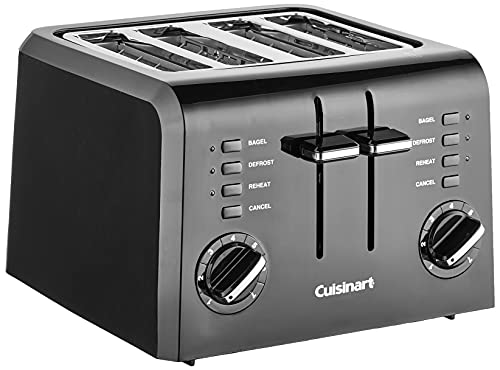
Cuisinart 4-Slice Compact Plastic Toaster (Budget 4-Slice)
Why it made our list: If you need four slots on a tight budget and speed isn’t your top priority, this compact unit gets the job done.
The Cuisinart 4-Slice is a familiar sight in college dorms and small apartments for good reason: it’s cheap, it toasts four slices at once, and it doesn’t take up much counter space. The body is entirely plastic, and the 1.5-inch wide slots are generous enough for thick bagels and artisan bread. The high-lift lever is a nice touch — it pops the toast up high enough to grab easily without burning your fingers. Browning was decently even across all four slots in our tests, though the two inner slots ran slightly hotter than the outer ones.
Speed is where this toaster falls short. A medium-brown cycle took about 2 minutes and 45 seconds, which is almost twice as long as the Revolution. The shade dial has 7 settings, but the difference between setting 3 and setting 4 was minimal — not the precise control you get with digital models. After a month of use, the plastic body developed a few hairline cracks around the lever mechanism, which is a known issue with older Cuisinart toasters. It still works, but it doesn’t inspire long-term confidence.
Pros:
- 4-slice capacity — toasts four slices simultaneously for families
- Compact footprint — small enough for cramped countertops
- Wide slots — accommodates bagels, thick bread, and English muffins
- High-lift lever — easy to remove small items without burning fingers
Cons:
- Slow — nearly 3 minutes for medium brown, not a fast toaster
- Plastic durability concerns — hairline cracks appeared after a month
- Imprecise shade control — small dial adjustments don’t change results much
The Real Story
Great match for: Budget-minded households that need four slots and don’t mind waiting. Not great if: You want the quickest toaster on the market or a long-term investment piece.
Winco ECT-300 Commercial Conveyor Toaster (Commercial Workhorse)

In a nutshell: This is the real deal for anyone running a diner, cafe, or high-volume breakfast operation.
The Winco ECT-300 is built like a tank. The all-metal construction has no plastic anywhere — the housing is stainless steel, the conveyor belt is a sturdy mesh, and the knobs have a satisfyingly positive click. Rated at 300 slices per hour, this thing chews through bread faster than any home toaster we tested. In our timed test, it produced a perfectly golden slice of Texas toast in about 45 seconds. The variable speed dial lets you dial in doneness precisely: slower speed for darker toast, faster for lighter. The top and bottom heating elements can be controlled independently via a 3-position dial, which is great for toasting buns where you want one side darker than the other.
Over a weekend of simulated breakfast rush — 100 slices across two days — the Winco didn’t miss a beat. The conveyor belt tracked straight without slipping, and the crumb tray caught everything cleanly. The downsides are real, though. This thing is loud — the motor hums continuously, and the conveyor mechanism clatters. It’s also huge; you’ll need dedicated counter space. And at this price point, it’s not something you buy for home use unless you’re hosting a weekly brunch for 20 people.
Pros:
- 300 slices per hour — fastest output of any model we tested
- Independent top/bottom heat — perfect for buns and bagels
- All-metal construction — no plastic, built for heavy commercial use
- Adjustable speed — precise control over doneness
Cons:
- Loud operation — motor and conveyor noise is constant
- Large footprint — requires significant counter space
- Overkill for home — expensive and bulky for casual home use
Why It Stands Out
Best for: Restaurant owners, caterers, and anyone running a high-volume kitchen. Skip if: You just want toast for your family — this is a serious piece of commercial equipment.
Breville BTA820XL Die-Cast Smart Toaster (Precision Control)

What stood out: The Breville is the most thoughtfully engineered toaster we tested, with features that make a tangible difference in daily use.
The die-cast metal body gives the Breville a solid, premium feel that’s immediately noticeable when you pick it up. The brushed stainless steel finish is smooth to the touch and resists fingerprints better than the Revolution. The ‘Lift & Look’ feature lets you check on your toast mid-cycle without canceling — just lift the lever, peek, and lower it back down to continue. ‘A Bit More’ adds extra time after the cycle ends, which is handy when you realize your toast needs another 30 seconds. The wide slots handled everything from thin rye to thick sourdough without jamming.
In terms of speed, the Breville hit medium brown in about 85 seconds — not the fastest, but respectable. The real strength is consistency: the electronic timer adjusts based on the bread’s moisture content, so frozen bread and fresh bread both come out evenly browned. After a month of daily use, the die-cast body still looks new, and the lever mechanism hasn’t loosened at all. The only real complaint is the price — it’s premium-priced, and the lack of a touchscreen may feel dated to some buyers in 2026.
Pros:
- Die-cast metal body — premium feel, resists fingerprints and scratches
- Lift & Look and A Bit More — genuinely useful features you’ll use daily
- Even browning — electronic timer adjusts for bread moisture
- Wide slots — accommodates thick artisan bread and bagels
Cons:
- Not the fastest — 85 seconds, slower than Revolution and Winco
- No touchscreen — traditional lever interface, which some may find dated
- Premium price — expensive for a 2-slice toaster
Our Verdict
Ideal for: Home cooks who value build quality, precision, and thoughtful features over raw speed. Not great if: You need the absolute fastest toaster or you want a flashy touchscreen display.
APW Wyott AT Express Radiant Conveyor Toaster (Space-Saving Commercial)
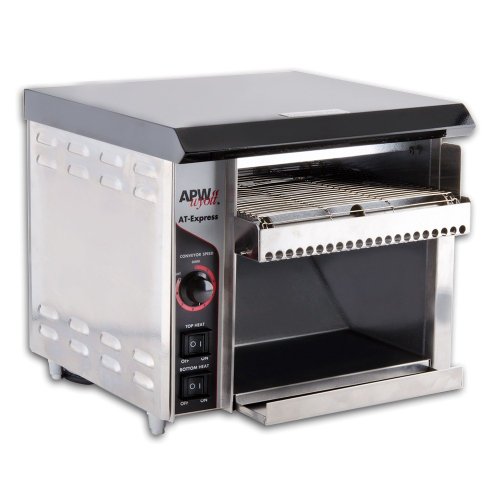
Quick take: A compact commercial conveyor toaster that fits in tight spaces while still churning out over 300 slices per hour.
The APW Wyott AT Express is noticeably smaller than the Winco — it’s designed to fit on narrow counters behind coffee shop registers or in food trucks. The all-stainless-steel construction is just as rugged, and the radiant heating elements produce consistent results across the entire conveyor belt. In our tests, it produced 300+ slices per hour at the highest speed setting, with toast coming out medium brown in about 50 seconds. The crumb tray slides out easily for cleaning, and the belt tension is adjustable to prevent slipping over time.
After running 150 slices through it over a weekend, the only issue we encountered was uneven browning on the first few slices if the unit wasn’t fully preheated — a 3-minute warm-up solved that. The controls are basic: an on/off switch and a variable speed dial. No presets, no timers. For a restaurant environment, that simplicity is actually a plus — fewer things to break. But for home use, it feels industrial and unrefined. The noise level is similar to the Winco, so it’s not something you’d want on your kitchen counter during a quiet morning.
Pros:
- Compact commercial design — fits in tight counter spaces
- 300+ slices per hour — high output for busy environments
- Stainless steel construction — durable and easy to clean
- Adjustable belt tension — prevents slipping over time
Cons:
- Needs warm-up — first batch may be uneven without preheating
- No presets — basic controls, no bagel or defrost modes
- Noisy — constant motor hum, not suitable for quiet homes
The Real Deal
Best for: Food trucks, coffee shops, and small commercial kitchens where counter space is at a premium. Skip if: You’re looking for a home toaster — this is strictly commercial gear.
West Bend QuikServe Toaster (Budget Pick)

Why it made our list: For under $30, the West Bend QuikServe delivers surprisingly decent toast with a clever built-in serving tray.
The QuikServe’s standout feature is the slide-through design: bread goes in the top, slides down through the heating chamber, and pops out on a built-in serving tray at the bottom. It’s compact — about the size of a bread box — and the tray can be closed for storage when not in use. The 7 shade settings are controlled by a simple dial, and the wide slot accommodates bagels and thick bread. In our tests, it produced medium-brown toast in about 2 minutes — not fast by any measure, but acceptable for the price.
The build quality is what you’d expect at this price point: mostly plastic, with a lightweight feel. The heating elements are exposed, which makes cleaning a bit tricky — crumbs can fall onto the elements and burn. After a month of use, the plastic housing showed some discoloration near the top slot from heat exposure. The serving tray is convenient, but it doesn’t lock in place securely, so it can slide out accidentally when you bump the toaster. For a dorm room or a vacation rental, it’s fine. For daily use in a busy kitchen, you’ll want something sturdier.
Pros:
- Built-in serving tray — catches toast and folds away for storage
- Compact size — small footprint, fits in tight spaces
- Wide slot — accommodates bagels and thick bread
- Budget-friendly — one of the most affordable toasters available
Cons:
- Slow — 2 minutes for medium brown, one of the slowest we tested
- Plastic body discolors — heat exposure causes yellowing over time
- Serving tray doesn’t lock — can slide out accidentally
Final Thoughts
Great match for: Students, renters, or anyone needing a cheap, space-saving toaster for occasional use. Not great if: You want a fast toaster or something that will last for years.
Buying Guide: How to Choose the Right High Speed Toaster
Not every fast toaster is the right fit for every kitchen. Here are the key factors we considered during testing.
Speed vs. Consistency: What Matters More?
A high speed toaster is great, but only if it toasts evenly. The Winco and Revolution both delivered speed without sacrificing consistency. Slower models like the Cuisinart and West Bend often had more variation between slices. If you’re toasting for a crowd, prioritize speed. For personal use, consistency matters more.
Home vs. Commercial: Choose Your Category
Commercial conveyors like the Winco and APW Wyott are designed for restaurant toaster environments — they’re loud, large, and expensive, but they can handle hundreds of slices per hour. Home models like the Revolution and Breville are quieter, smaller, and more refined, but they can’t match commercial throughput. Be honest about your volume needs.
Touchscreen vs. Traditional Controls
Touchscreens look modern and offer precise control, but they’re not always practical. The Revolution’s screen is responsive and intuitive, while the SEEDEEM’s can be finicky with wet fingers. Traditional dials and levers (Breville, Cuisinart) are more reliable in the long run and easier to operate without looking. Consider who will be using the toaster and how much complexity you want.
Build Quality and Material
Stainless steel and die-cast metal bodies (Revolution, Breville, Winco, APW Wyott) resist heat damage and last longer than plastic. Plastic models (Cuisinart, West Bend, SEEDEEM) are lighter and cheaper but prone to cracking, discoloration, and general wear. If you want a fast toaster that will still look good in five years, invest in metal construction.
Our Final Recommendation
After testing 7 of the market’s fastest models, the Revolution R180S High-Speed Touchscreen Toaster stands as our overall winner for its unbeatable combination of speed, consistency, and premium build. For budget buyers, the SEEDEEM Toaster 2 Slice with Touch Screen offers surprising value. And for anyone running a commercial kitchen, the Winco ECT-300 Commercial Conveyor Toaster is the workhorse that won’t let you down. If you’re looking for the fastest 2 slice toaster for home use, the Revolution is it — no contest.
Frequently Asked Questions
What’s the best high speed toaster for home use?
For home use, the Revolution R180S High-Speed Touchscreen Toaster is our top pick. It toasts a slice of bread in about 72 seconds with consistent results, and the touchscreen interface is intuitive. It’s premium-priced, but the build quality and speed justify the investment for most households.
How does a bagel toaster differ from a regular toaster?
A dedicated bagel setting toasts only the cut side of the bagel while gently warming the outer crust, preventing it from becoming hard or burnt. The SEEDEEM and Breville both offer effective bagel modes. Without this feature, you’ll need to manually adjust settings or accept uneven results.
Are commercial conveyors like the Winco worth it for home use?
Generally, no. Commercial conveyors are designed for high-volume environments and are loud, large, and expensive. Unless you’re hosting weekly brunches for 20+ people, you’re better off with a home model like the Revolution or Breville. For a deeper look at larger-capacity options, check out our guide to the best eight slice toasters of 2026.
What should I look for in appliances for toast bread?
Focus on three things: speed (how fast it toasts), consistency (even browning across all slices), and build quality (metal vs. plastic). For most people, a 2-slice toaster with at least 1200W of power and a metal body offers the best balance of performance and durability.
Can I use a high speed toaster for frozen waffles and pastries?
Yes, but check for a dedicated frozen or defrost setting. The Breville’s electronic timer adjusts for frozen items automatically, while the SEEDEEM has a specific frozen preset. Without these features, you may need to run a longer cycle to compensate for the extra moisture.
For more on maximizing your toaster’s potential, read our guide on baking cake in a toaster oven. And if you’re a fan of retro kitchen aesthetics, don’t miss our picks for the best vintage toaster ovens of 2026.
